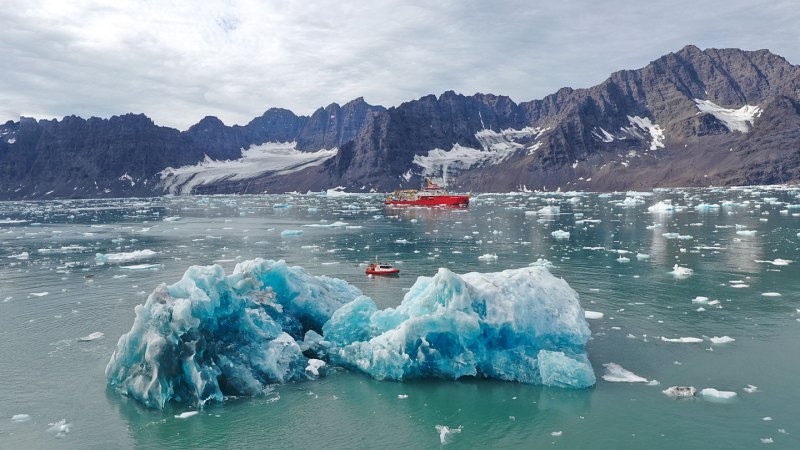
Researchers deployed a swarm of autonomous robots across Greenland's ice sheets to gather critical data about how glaciers meet the ocean, work that could improve predictions of sea-level rise and climate tipping points.
The robot swarm operates in one of Earth's harshest environments, collecting measurements along the glacier-sea boundary where rapid ice loss accelerates. Scientists need detailed information from this interface to refine climate models, particularly as warming temperatures destabilize Greenland's massive ice sheet, which holds enough frozen water to raise global sea levels by approximately 7 meters if it melts entirely.
The expedition addresses a significant gap in existing climate science. While satellites provide valuable data about surface changes, they cannot adequately monitor subsurface conditions and ocean temperatures near glacier fronts, where some of the most dramatic ice loss occurs. The autonomous robots can access areas difficult or dangerous for human researchers to study, collecting temperature, salinity, and bathymetric data that feed into predictive models.
This work matters because Greenland represents a potential climate tipping point. Once ice loss accelerates past certain thresholds, feedback mechanisms like reduced surface albedo—where darker exposed rock absorbs more sunlight—could trigger runaway melting independent of future emissions reductions. Understanding the precise conditions that trigger such feedbacks requires the granular data only close-range measurement campaigns can provide.
The robot swarm approach offers advantages over traditional ship-based research. Autonomous systems can operate continuously in dangerous conditions, collect data at higher spatial resolution, and operate more cost-effectively than crewed expeditions. The coordinated swarm design allows simultaneous measurements across multiple locations, creating a more complete picture of glacier-ocean interactions.
Limitations remain. The robots operate only during favorable weather windows, and their battery life constrains mission duration. Data collected from one season provides a snapshot, not long-term trends. Researchers must compare these