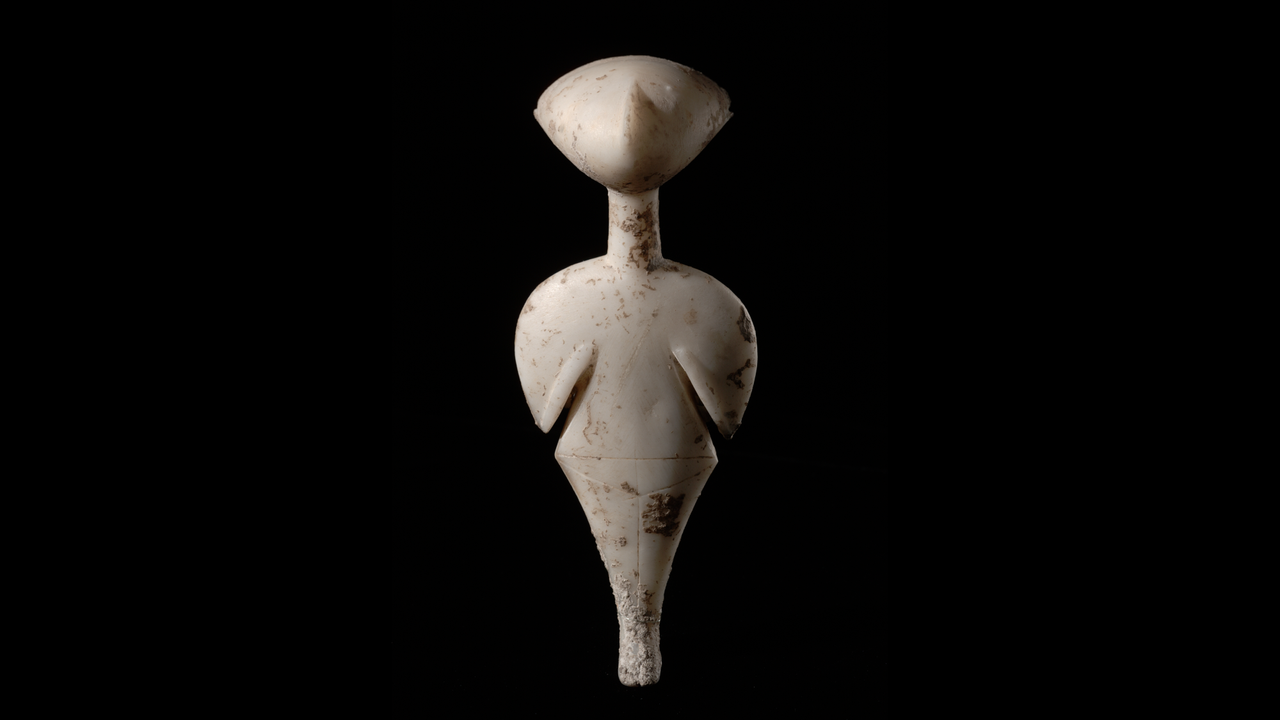
Archaeologists have identified a remarkable 5,000-year-old marble statuette depicting a woman gazing upward, adding to a rare collection of Stone Age figurines that scholars are only beginning to understand.
The statuette belongs to a small group of these delicate marble carvings, produced by Neolithic populations in the Aegean region during the early Bronze Age. These figurines share distinctive characteristics: smooth, minimalist forms and a consistent pose of the figure with head tilted back. The upward gaze remains one of their most intriguing features, yet archaeologists still debate its meaning.
Only a handful of these objects survive today, making each discovery valuable for understanding ancient symbolism and artistic traditions. The figurines typically stand a few inches tall and were fashioned from white or gray marble, materials quarried locally in the Cycladic islands and mainland Greece.
Researchers have proposed multiple interpretations for the skyward pose. Some suggest the figures represent a religious or spiritual practice, perhaps connected to celestial observation or ritual activity. Others argue they may depict a specific mythological narrative or represent a symbolic gesture tied to fertility, mourning, or shamanic practices.
The attribution to "Stone Age people" reflects the Neolithic to early Bronze Age period when these cultures flourished. These societies left few written records, making archaeological artifacts the primary evidence for reconstructing their beliefs and daily life.
The minimal stylization of these figurines contrasts sharply with later Greek sculpture, indicating that Neolithic artists operated within a different aesthetic framework and cultural context. Their purpose remains enigmatic. They may have served religious functions, served as toys, or held social meaning within community rituals.
Experts continue to examine these rare objects through new archaeological and forensic techniques. Each newly documented statuette provides additional context for understanding this mysterious artistic tradition. The recurring upward gaze across multiple examples suggests deliber