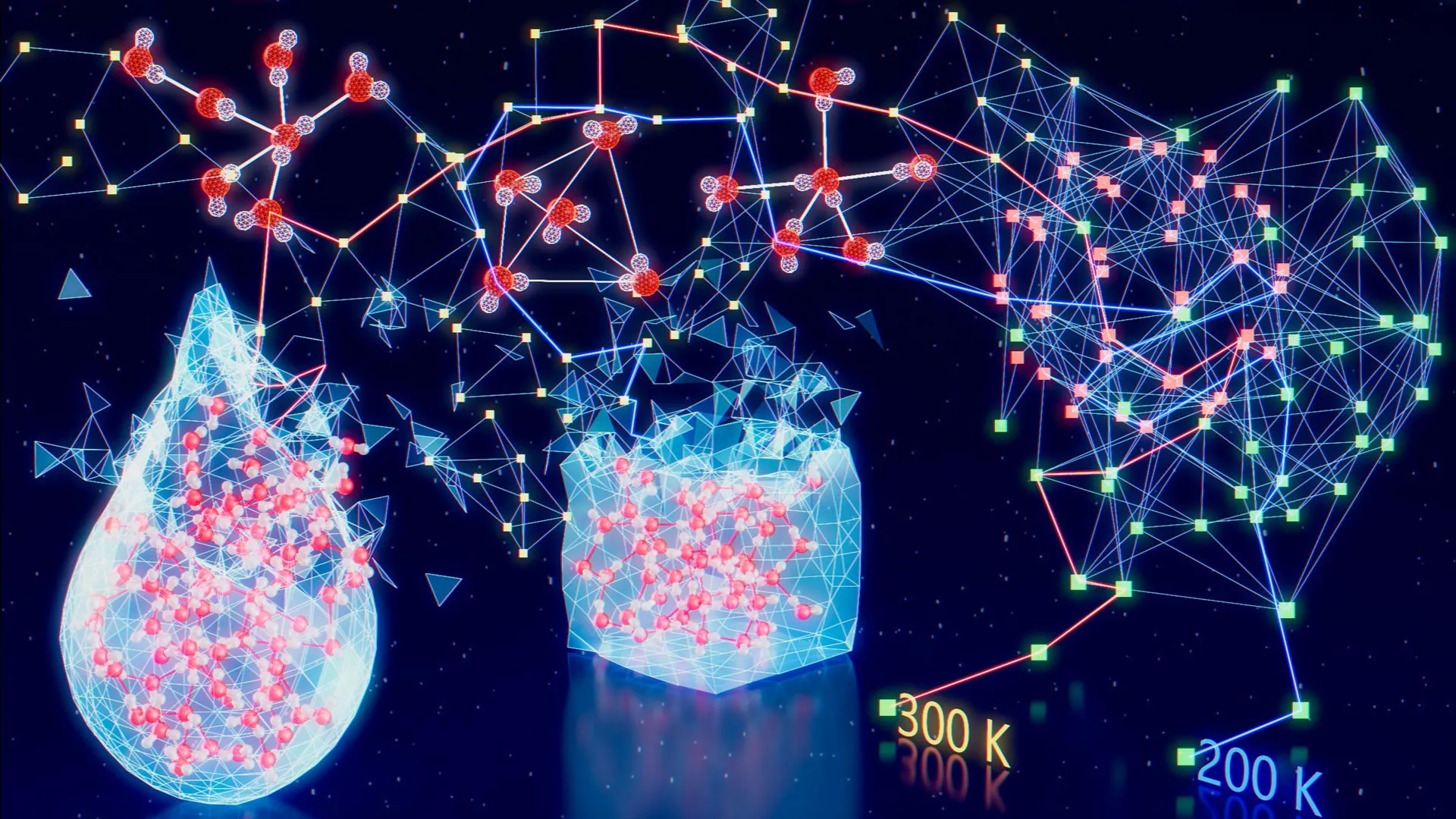
Researchers at the University of Osaka deployed artificial intelligence to resolve a longstanding puzzle about water's molecular structure in its supercooled state. Water exhibits anomalous properties as temperatures drop below freezing, but scientists lacked a unified way to describe its microscopic arrangement at these conditions.
The team trained an AI model on computer simulations to evaluate 16 different structural descriptors, each offering a distinct way to characterize water molecules. The AI identified which descriptors most effectively distinguished between two competing liquid states that water can occupy when supercooled. This competition between states explains water's unusual behavior, including density anomalies and unusual thermal properties.
The research, conducted by physicists at Osaka University, represents a shift toward machine learning methods in fundamental chemistry. Rather than manually comparing descriptors, the AI system systematically ranked their ability to differentiate the two liquid phases. The most effective descriptors emerged as the clearest lenses for understanding supercooled water's behavior.
Water's anomalies have puzzled scientists for decades. Unlike most liquids, water becomes less dense as it freezes, which is why ice floats. The supercooled regime, where water remains liquid below 0 degrees Celsius, intensifies these puzzles. Some models suggest two competing liquid structures vie for dominance at low temperatures, but researchers have struggled to measure or visualize this competition directly.
The AI approach sidesteps this problem by finding the optimal mathematical language to describe the phenomenon. By identifying which descriptors best capture the distinction between the two proposed liquid states, the framework provides a more reliable foundation for future experiments and simulations.
The study's limitations should be noted. The AI was trained exclusively on computer simulations, not experimental data. Whether these descriptors perform equally well when applied to real supercooled water samples remains untested. Additionally, the research clarifies description rather than definitively proving the two