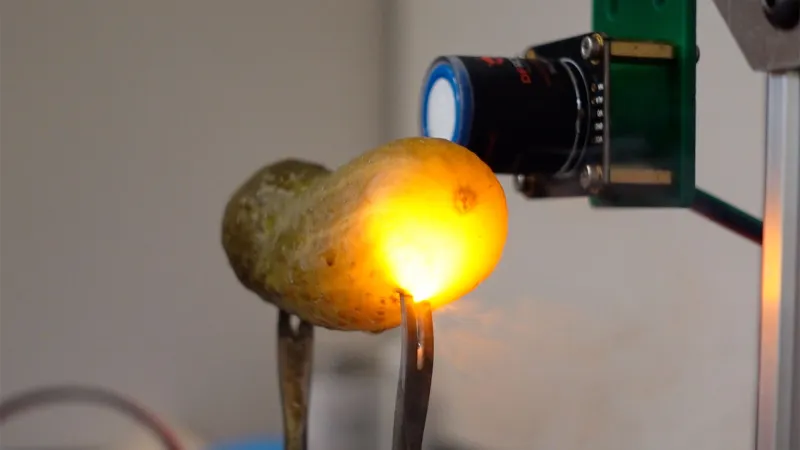
A jar of pickles connected to electrical current produces a striking glow, a phenomenon rooted in basic plasma physics rather than magic. When researchers apply high voltage across pickle brine, the salty liquid conducts electricity and ionizes, creating plasma that emits visible light.
Pickles work as conductors because they contain sodium chloride dissolved in water. Salt dissociates into ions, allowing electric current to flow between two electrodes inserted into the brine. As voltage increases, the current heats the solution and energizes atoms and molecules. Electrons jump to higher energy states, then release that energy as photons when they return to their ground state. This process, called recombination, generates the characteristic glow.
The specific color depends on the ions present. Sodium produces a yellow-orange glow, while other elements in the brine create different wavelengths. The effect appears most dramatic in dim lighting because the plasma brightness becomes more visible against a dark background.
This demonstration illustrates principles underlying neon signs, which operate on the same basic mechanism. Gases inside neon tubes ionize under high voltage and emit light at wavelengths determined by their atomic structure. Pickles simply substitute for the gas, using salt water as the ionizable medium.
The experiment works reliably because pickles contain optimal conditions for plasma formation. The brine's conductivity allows sufficient current flow without requiring dangerously high voltages. Home demonstrations typically use standard electrical outlets, making this a relatively safe way to visualize plasma physics.
While the glowing pickle serves as an engaging educational tool, it demonstrates real physics applicable to industrial processes, lighting technology, and medical equipment. The visualization helps students understand how ions, energy levels, and photon emission connect in everyday phenomena. Science educators frequently use this demonstration because it combines visual impact with conceptual clarity.
The experiment remains popular at science museums and classrooms precisely because it transforms a