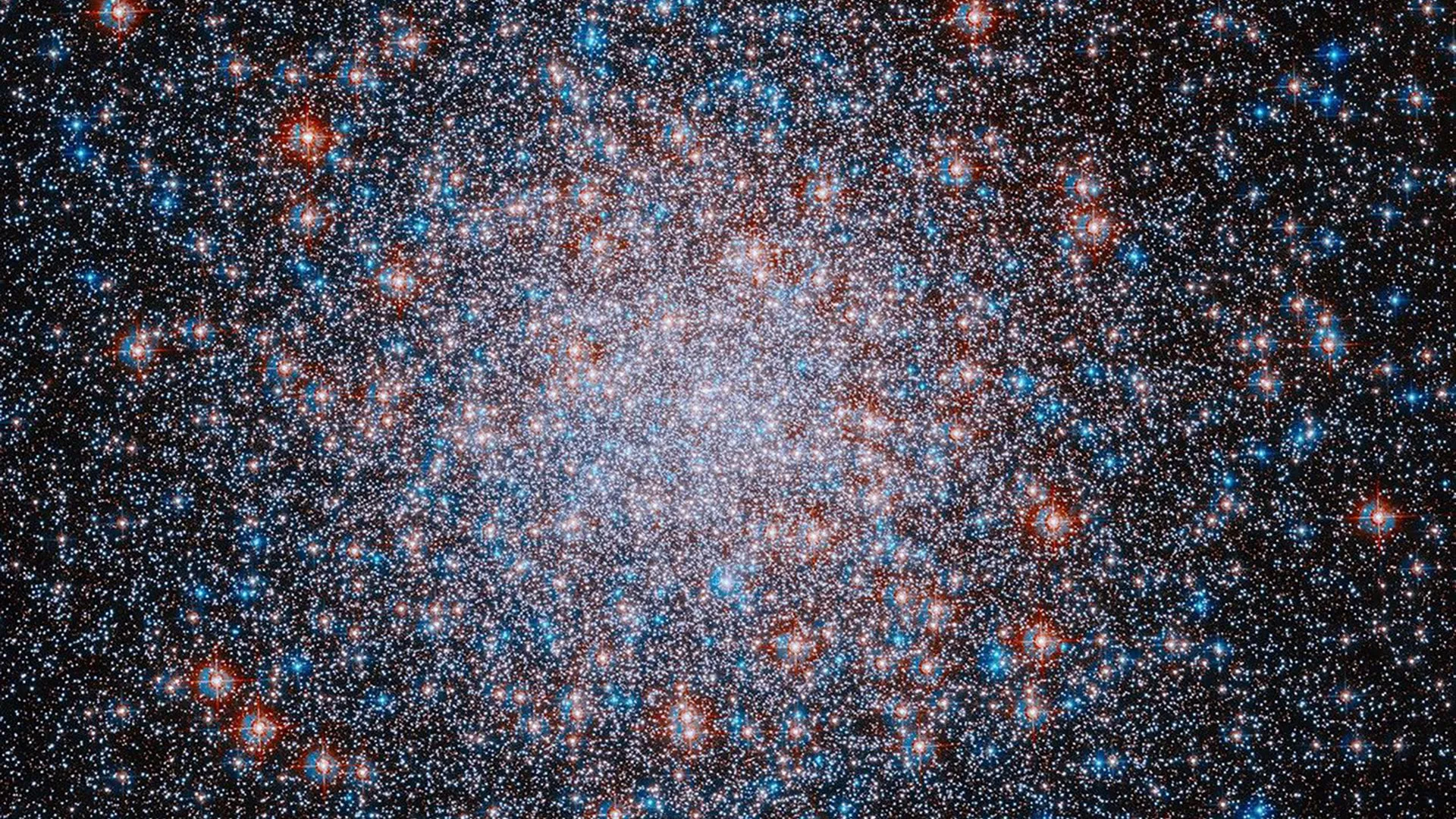
NASA released a Hubble Space Telescope image of Messier 3 on the occasion of the United States' 250th anniversary, capturing over 500,000 stars within the ancient globular cluster. The photograph reveals one of the densest stellar collections visible from Earth, located approximately 33,600 light-years away in the constellation Canes Venatici.
Globular clusters like Messier 3 serve as cosmic laboratories for astronomers studying galactic history. These spherical collections formed billions of years ago and contain some of the oldest stars in the Milky Way. The cluster's composition, including rare stellar types found within its core, provides clues about how galaxies assembled and evolved over time.
Researchers use Hubble observations to map the cluster's stellar populations and measure the ages of individual stars through their colors and brightness. This data helps trace the formation history of our galaxy. The density of stars in globular clusters makes them difficult to resolve from ground-based telescopes, but Hubble's optical capabilities distinguish individual stars even in crowded regions.
Messier 3 holds particular scientific interest because evidence suggests it may have originated from a galactic merger in the Milky Way's distant past. When galaxies collide, they can capture satellite galaxies whole, incorporating their globular clusters into the larger galaxy's system. By studying clusters like Messier 3, astronomers reconstruct these merger events and understand how the Milky Way grew to its present size and structure.
The Hubble observation combines light gathered across multiple wavelengths to create the portrait, with colors assigned to highlight different stellar populations. Blue stars represent young, massive objects, while red stars indicate older, cooler ones. This imaging technique reveals the cluster's internal structure and composition with unprecedented clarity.
Such observations contribute to broader efforts to create a timeline of galactic assembly. Understanding