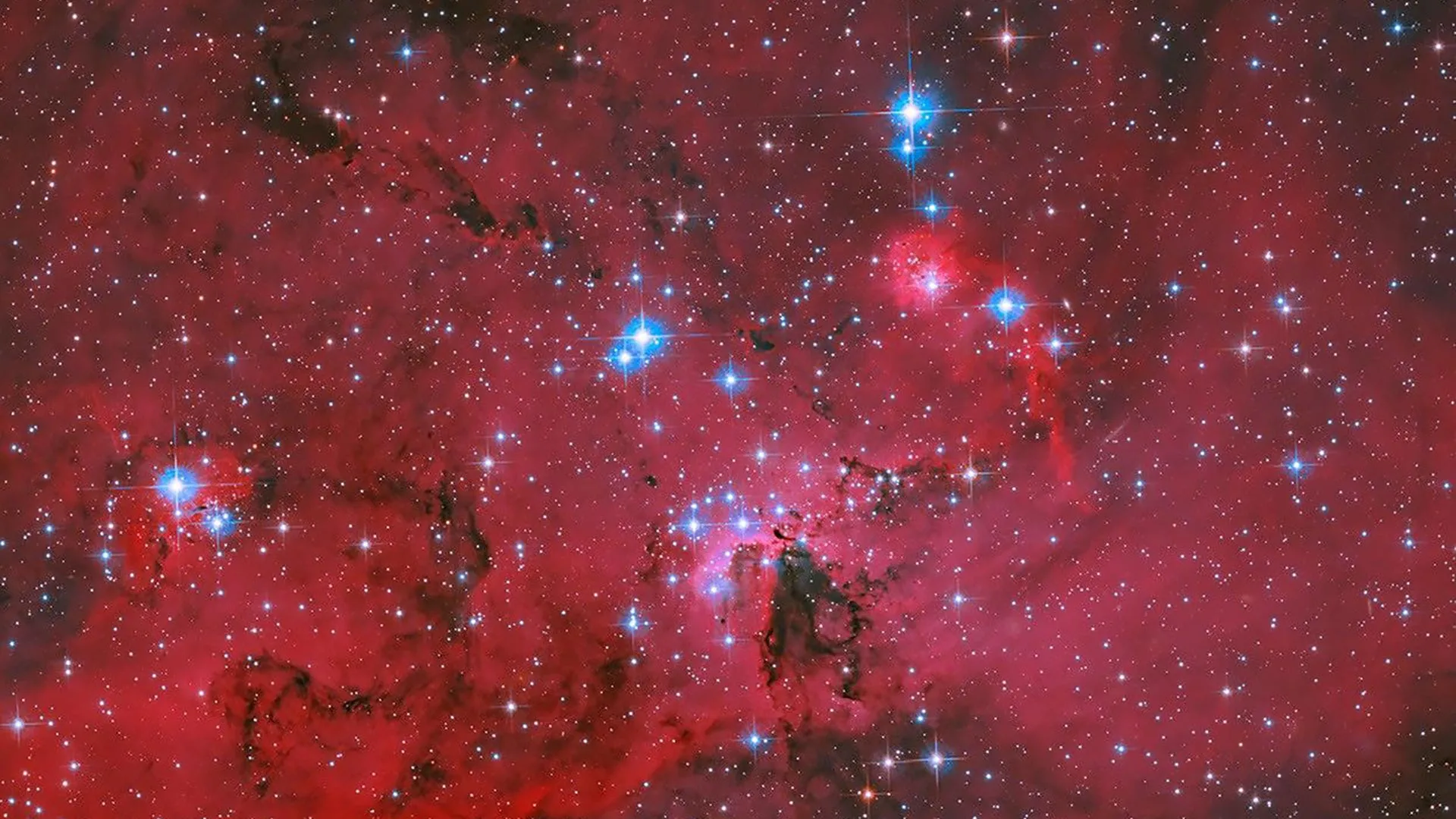
NASA's Hubble Space Telescope has photographed LH 95, a stellar nursery located in the Large Magellanic Cloud, revealing roughly 2,500 young stars embedded in glowing red hydrogen gas clouds punctuated by brilliant blue and white stellar objects.
The image provides astronomers with new insights into stellar development timescales. Researchers discovered that protostars in this region continue accumulating gas and dust for millions of years, substantially longer than previously understood. This extended accretion phase represents a critical stage where young stars gain mass before entering their mature lifecycle.
LH 95 contains multiple generations of stars at different evolutionary stages occupying the same region. This coexistence offers researchers a natural laboratory to study how star formation progresses across extended periods. The interplay between younger and older stellar populations helps clarify the mechanisms driving galactic star birth.
The Large Magellanic Cloud location provides distinct advantages for this research. As a satellite galaxy orbiting the Milky Way at roughly 160,000 light-years distance, it remains close enough for detailed observation yet far enough to allow study of entire star-forming regions as integrated systems. The reduced metallicity of the Large Magellanic Cloud compared to our galaxy also makes stellar development patterns there somewhat distinct from Milky Way observations.
Hubble's advanced imaging capabilities captured the spectrum of LH 95 across multiple wavelengths, allowing astronomers to distinguish young stars of varying ages and masses. The crimson hydrogen emission dominates the background, tracing ionized gas heated by intense radiation from the hottest, most massive stars in the region.
These findings refine models of stellar formation that inform our understanding of how galaxies assemble and evolve. The extended timescale for protostellar mass accumulation suggests previous calculations underestimated how long stars remain in their formative phases. This correction carries implications