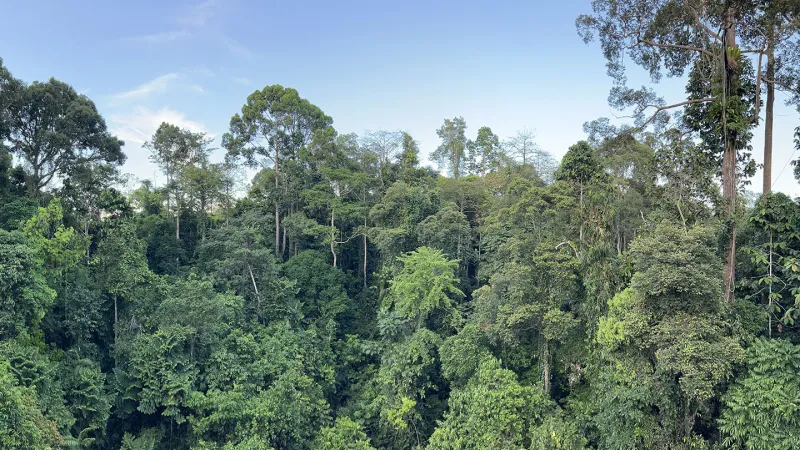
Researchers studying giant trees at extreme heights have gathered the first direct evidence for how the world's tallest trees survive droughts, according to work reported in Science News.
Scientists collected samples from the crowns of coast redwoods and other large trees, scaling to daring heights to test competing theories about tree physiology during water stress. The findings validate one long-standing hypothesis while undermining another about how trees manage limited water availability.
The research addresses a fundamental puzzle in forest ecology. Tall trees face a particular challenge during droughts because water must travel hundreds of feet upward against gravity, and the tension in the water column increases with height. Scientists have debated whether trees prevent catastrophic failure of their water transport systems by reducing leaf area, closing stomata (pores that regulate gas exchange), or both.
By accessing the uppermost branches directly, researchers examined leaf physiology and water status at heights previously inaccessible to study. The team measured stomatal conductance, water potential, and other indicators of drought stress across the canopy profile. Their data showed that large trees employ specific strategies that earlier laboratory work had proposed but never been confirmed in nature.
The findings have implications for predicting forest responses to climate change. Prolonged droughts now common in western North America place particular stress on tall trees, which already operate near their physiological limits. Understanding exactly how these trees respond to water scarcity helps explain which forests might persist through future dry periods and which may face decline.
The work also challenges assumptions built into some forest models used by climate scientists and land managers. If tall trees use different drought-coping strategies than smaller trees, forest models need refinement to account for this variation. This matters for carbon accounting, water availability projections, and timber management decisions across regions where drought stress is increasing.
The research underscores how direct observation at extreme scales can overturn laboratory assumptions and reveal nature's actual solutions to physical constraints