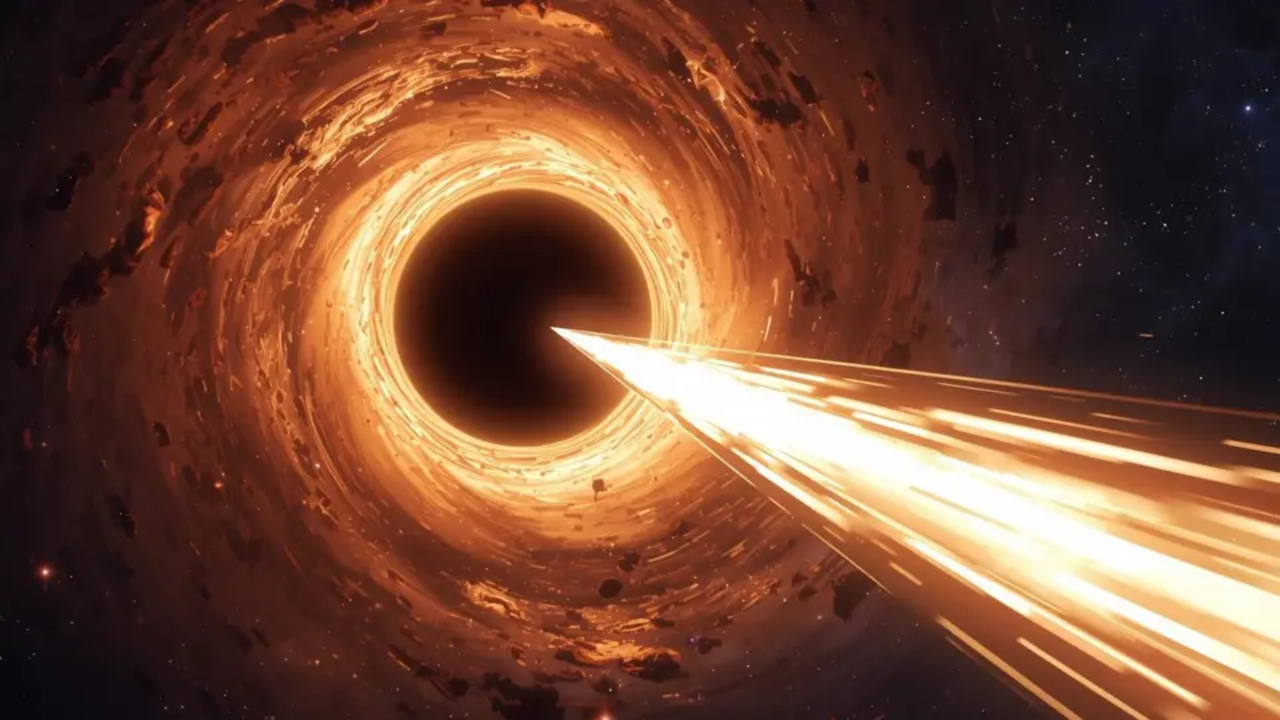
Astronomers have identified a black hole in a nearby galaxy that exhibits feeding behavior matching supermassive black holes from the early universe, just hundreds of millions of years after the Big Bang.
The discovery offers a rare local laboratory for studying how the most extreme objects in the cosmos consumed matter in the ancient universe. Black holes in the early cosmos grew to extraordinary masses far faster than current models predict, and this nearby feeding black hole provides astronomers an opportunity to observe similar processes without requiring the infrared telescopes needed to peer billions of light-years back in time.
The black hole's voracious feeding pattern, characterized by rapid accretion of surrounding material, mirrors the behavior of quasars and active galactic nuclei observed in the distant early universe. By studying this closer analog, researchers can test theories about black hole growth mechanisms and how these objects shaped galaxy evolution in the cosmos's infancy.
The research highlights an important limitation in astronomy. Direct observations of early universe black holes remain challenging despite advanced instruments like the James Webb Space Telescope. These distant objects appear faint and require extensive observation time. A nearby black hole exhibiting comparable behavior allows scientists to gather detailed spectroscopic data, measure accretion rates with precision, and examine the physics of extreme matter consumption under conditions that would otherwise require traveling billions of light-years away.
Understanding how black holes in the early universe grew so rapidly addresses one of cosmology's persistent puzzles. The standard cold dark matter model struggles to explain the discovery of billion-solar-mass black holes existing when the universe was less than a billion years old. A nearby feeding black hole replicating that behavior could reveal the mechanisms that allowed such rapid growth.
This work demonstrates how local cosmic objects can serve as time machines of sorts, allowing physicists to recreate and study conditions from the ancient universe without waiting for next-generation telescopes or investing months of observation time on overbooked facilities.
CATEGORY