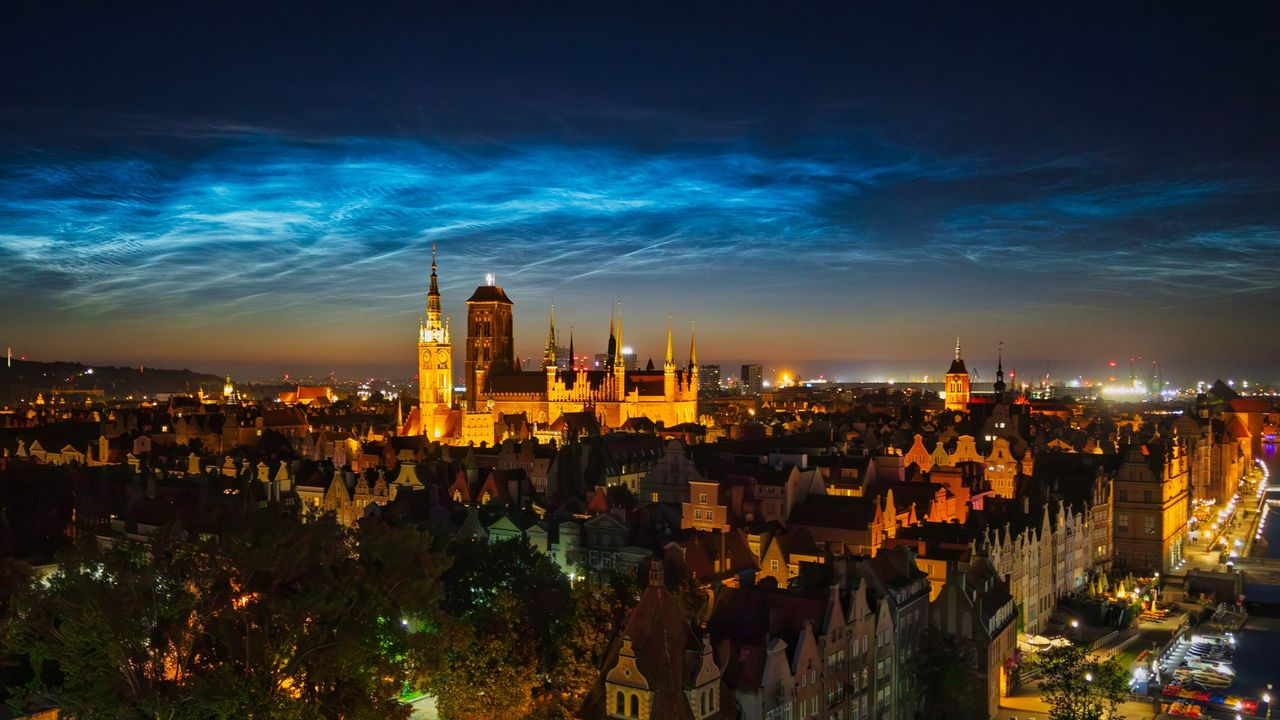
Noctilucent clouds offer skywatchers a rare visual treat during summer months. These luminous ice formations drift at altitudes around 80 kilometers, near the boundary between Earth's atmosphere and space. The clouds earn their name from their ability to glow even after sunset, when sunlight still illuminates them from below while the ground remains in darkness.
The phenomenon occurs when water vapor rises to the mesosphere during warm seasons. At such extreme heights, temperatures plummet to around minus 120 degrees Celsius, causing moisture to freeze into ice crystals. These crystals scatter sunlight in distinctive ways, producing the characteristic silvery-blue shimmer that makes noctilucent clouds visually striking.
Observation windows remain narrow. The clouds appear most frequently during twilight hours, roughly 30 to 60 minutes after sunset or before sunrise. Viewers positioned at higher latitudes between 50 and 70 degrees north or south have the best chances of spotting them. The optimal viewing season runs from May through August in the Northern Hemisphere and November through February in the Southern Hemisphere.
Scientists monitor noctilucent clouds for clues about atmospheric conditions and climate patterns. Their presence correlates with mesospheric water vapor levels and temperature dynamics. Some research suggests their frequency has increased over recent decades, though the connection to climate change remains under investigation.
Spotting noctilucent clouds requires minimal equipment. Clear skies and an unobstructed view toward the northern (or southern) horizon work best. Binoculars enhance detail, though naked-eye observation captures their ethereal quality. The clouds often display rippled or wave-like patterns, sometimes appearing in bright bands that stretch across the sky.
Weather apps and dedicated astronomy websites provide real-time forecasts for noctilucent cloud activity. Sites like Space Weather Prediction Center track atmospheric conditions favorable