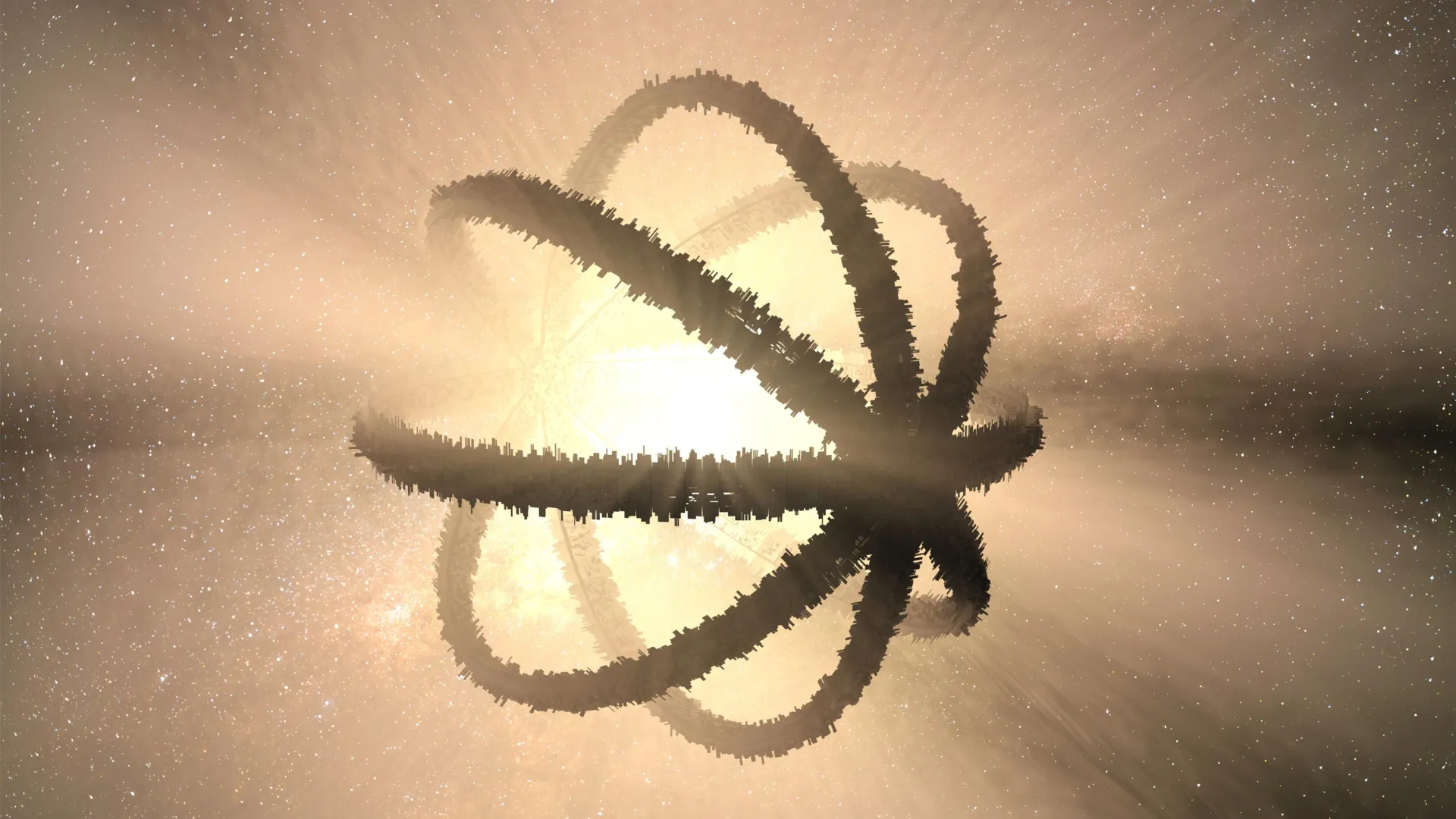
Astronomers have identified observational signatures that could reveal Dyson spheres, the hypothetical megastructures that advanced civilizations might build to harvest stellar energy. The research suggests that red dwarfs and white dwarfs represent the best targets for searches, since their smaller size and lower energy output make them ideal candidates for energy-harvesting swarms.
A Dyson sphere, proposed by physicist Freeman Dyson in 1960, describes a theoretical shell or swarm of solar collectors surrounding a star to capture its entire energy output. No confirmed examples exist, but the concept remains a central focus in the search for advanced extraterrestrial civilizations.
The study identifies three key detection methods. First, Dyson sphere structures would emit primarily in infrared wavelengths rather than visible light, since they absorb and re-radiate stellar energy. Second, they would lack the dusty, circumstellar signatures characteristic of natural stellar systems. Third, they might produce unusual flickering patterns as their components move or adjust position.
Red dwarfs represent particularly attractive targets because their lower luminosity means a civilization requires fewer collectors to achieve substantial energy capture. White dwarfs, despite their intense heat, also offer advantages due to their small size and potentially simpler engineering requirements. Both object types remain relatively common in the galaxy, expanding the search space significantly.
The research frames Dyson spheres as thermodynamically rational energy infrastructure for space-faring civilizations. Rather than futuristic speculation, the concept follows straightforward physics: any advanced society requiring increasing energy would eventually seek to tap stellar resources at scale.
Current infrared surveys like those from NASA's WISE mission and upcoming telescopes such as the James Webb Space Telescope could detect such structures if they exist. However, researchers acknowledge significant limitations. The signatures described could theoretically match natural phenomena in ways not yet fully understood. Distinguishing genuine megastruct