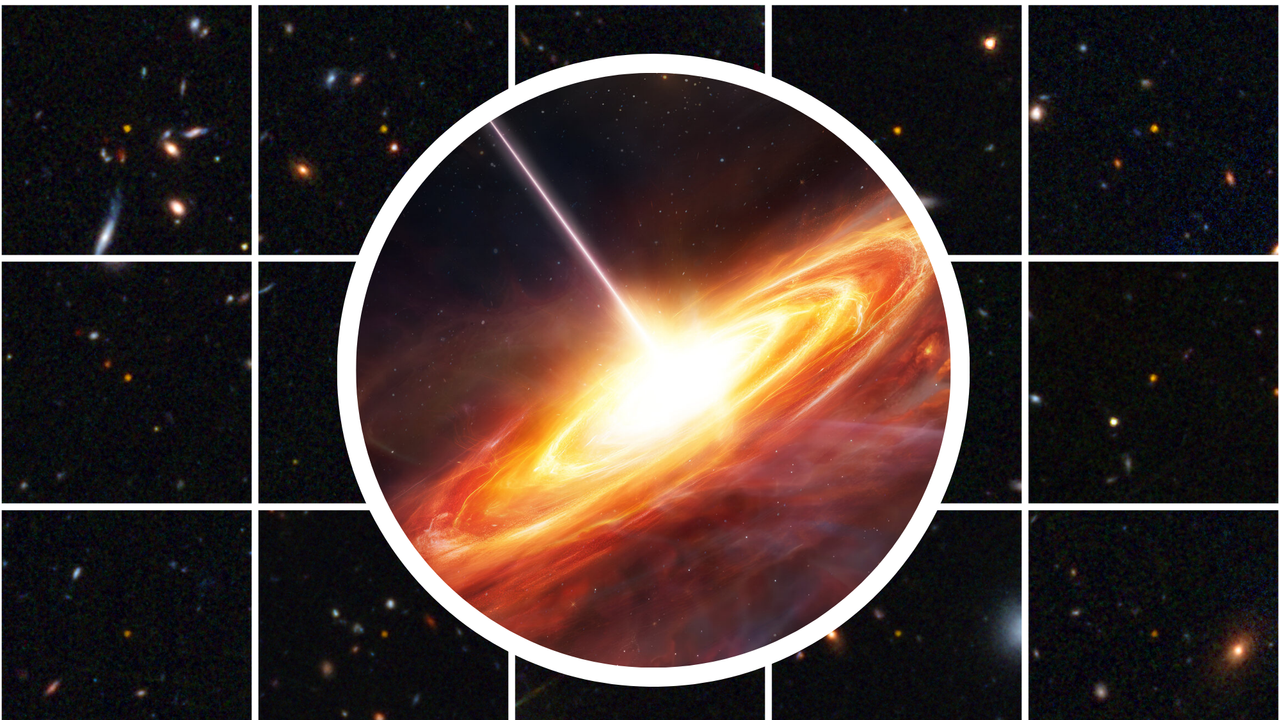
Astronomers using the European Space Agency's Euclid space telescope have identified the oldest and most distant quasar ever observed, along with numerous other black hole-powered quasars lurking in the early universe.
The discovery pushes back our understanding of supermassive black hole formation in cosmic history. Quasars are extraordinarily luminous objects powered by matter spiraling into supermassive black holes at galactic centers. The newly detected quasar shines with the brightness of approximately one trillion suns, making it visible across billions of light-years despite its extreme distance.
This find presents a puzzle for cosmologists. The existence of such luminous black holes so early in the universe's history challenges current models of how supermassive black holes grow. Standard formation theories suggest these objects required more time to accumulate mass through gradual accretion and galaxy mergers. Yet this ancient quasar contradicts that timeline, appearing when the universe was still in its infancy.
The Euclid telescope, launched by the European Space Agency, specializes in mapping the geometry of the universe and detecting distant galaxies and quasars. Its infrared capabilities allow it to peer through cosmic dust and identify objects whose light has traveled for billions of years. The instrument's sensitivity revealed not just one record-breaking quasar but an entire population of early black hole systems that warrant further study.
The researchers plan to conduct follow-up observations using ground-based telescopes to confirm distances and measure physical properties of these quasars. Understanding when and how supermassive black holes first formed remains a central question in astronomy, with implications for galaxy formation theory broadly.
This discovery underscores how new observatories like Euclid continue to rewrite cosmic history. Each generation of telescopes reveals objects older and more distant than previous instruments could detect, forcing scientists to reconsider fundamental theories about the