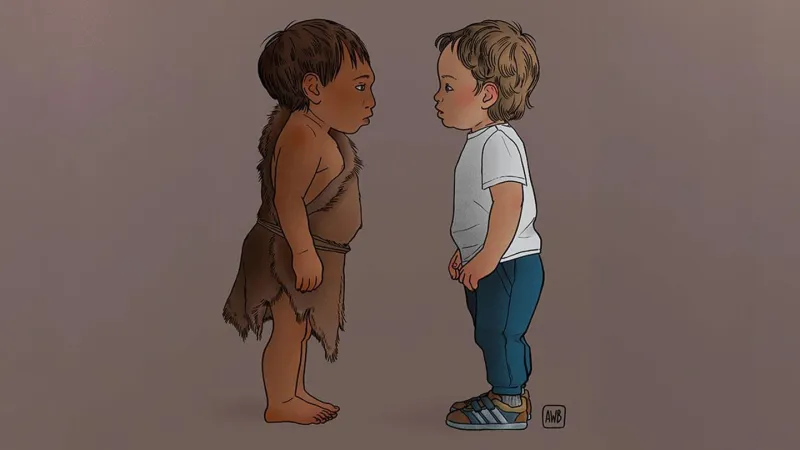
Neandertals were born at roughly the same size as modern human infants, but their early development trajectories diverged sharply from ours, according to two new studies of fossil remains.
Researchers examining Neandertal skeletal material found that newborns were comparable in birth weight and size to contemporary human babies. The critical difference emerged in infancy and childhood, when Neandertals accelerated through developmental stages faster than modern humans do.
This faster maturation shaped Neandertal physiology throughout their lives. The accelerated growth patterns contributed to their robust builds, shortened lifespans, and earlier reproductive maturity compared to modern humans. Modern humans extend their childhood and adolescence considerably, allowing for extended parental care, social learning, and brain development. Neandertals compressed this timeline.
The research examined bone growth markers and dental development in Neandertal fossils, comparing them against modern human and other hominin growth patterns. Researchers could reconstruct developmental rates by analyzing the microscopic growth lines preserved in tooth enamel and bone structure, similar to reading tree rings. These lines form at predictable intervals and reveal how quickly individuals matured.
The findings refine our understanding of Neandertal life history and suggest their cognitive and social organization reflected their faster developmental schedule. Extended childhood in modern humans provided an evolutionary advantage for acquiring complex skills and knowledge. Neandertals' faster development meant less time for such learning before reaching adulthood.
This research adds nuance to broader questions about how Neandertals differed from modern humans. While birth size remained equivalent, the divergence in developmental pacing created cascading effects across physiology, behavior, and longevity. The studies underscore how subtle shifts in developmental timing produce significant variations across species and populations.