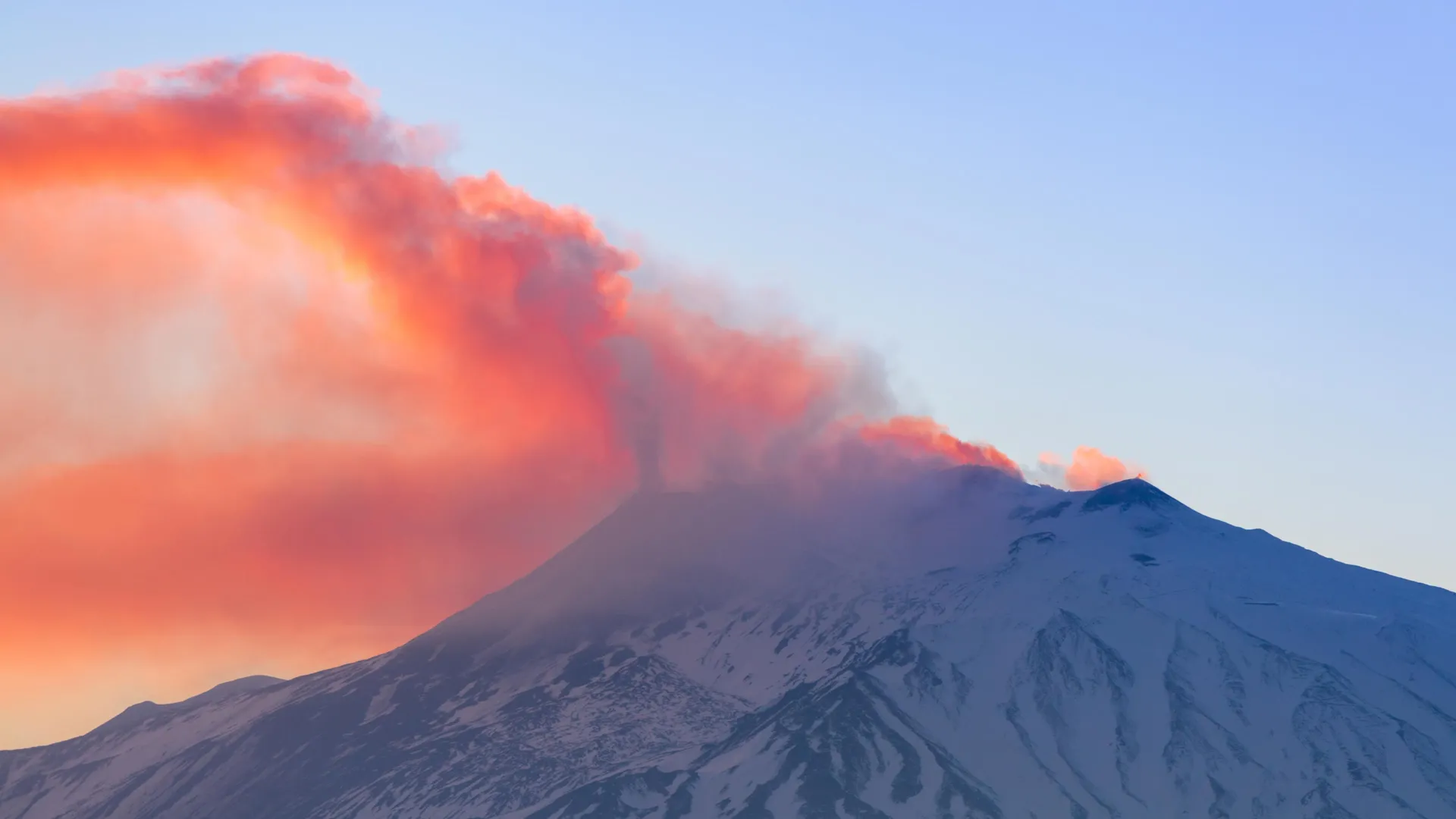
Mount Etna, Europe's most active volcano, defies the three standard geological models for how volcanoes form. A new study proposes that Etna belongs to a previously unrecognized fourth category, powered by ancient magma reservoirs pushed upward through fractures created by tectonic plate movement.
Geologists have long struggled to explain Etna's existence using conventional volcano formation theory. The three established mechanisms include volcanism at divergent plate boundaries, where plates pull apart; at convergent boundaries, where plates collide; and at hotspots, where stationary plumes of hot mantle material rise through the crust. Etna fits none of these patterns cleanly, creating a decades-old puzzle for researchers studying Sicily's iconic peak.
The research team examined how tectonic stress in the region creates pathways for magma movement. Rather than resulting from a single, sustained deep mantle source, Etna appears to tap into scattered pockets of ancient molten rock stored in the crust and upper mantle. Tectonic extension in the area—where the crust is being pulled apart—opens conduits that allow this trapped magma to ascend toward the surface. This mechanism differs fundamentally from classical volcano formation, which typically depends on either steady heat input or large-scale plate dynamics.
The discovery carries broad implications for volcanology. If Etna represents a true fourth category of volcanism, it suggests that substantially larger volcanoes can form through processes previously thought to generate only small-scale submarine eruptions. This reclassification could reshape how geologists search for and understand volcanic activity worldwide, particularly in regions experiencing tectonic stress.
The findings remain preliminary and require additional confirmation through seismic studies and compositional analysis of Etna's erupted materials. However, the study demonstrates that even well-studied volcanoes can reveal unexpected geological mechanisms.