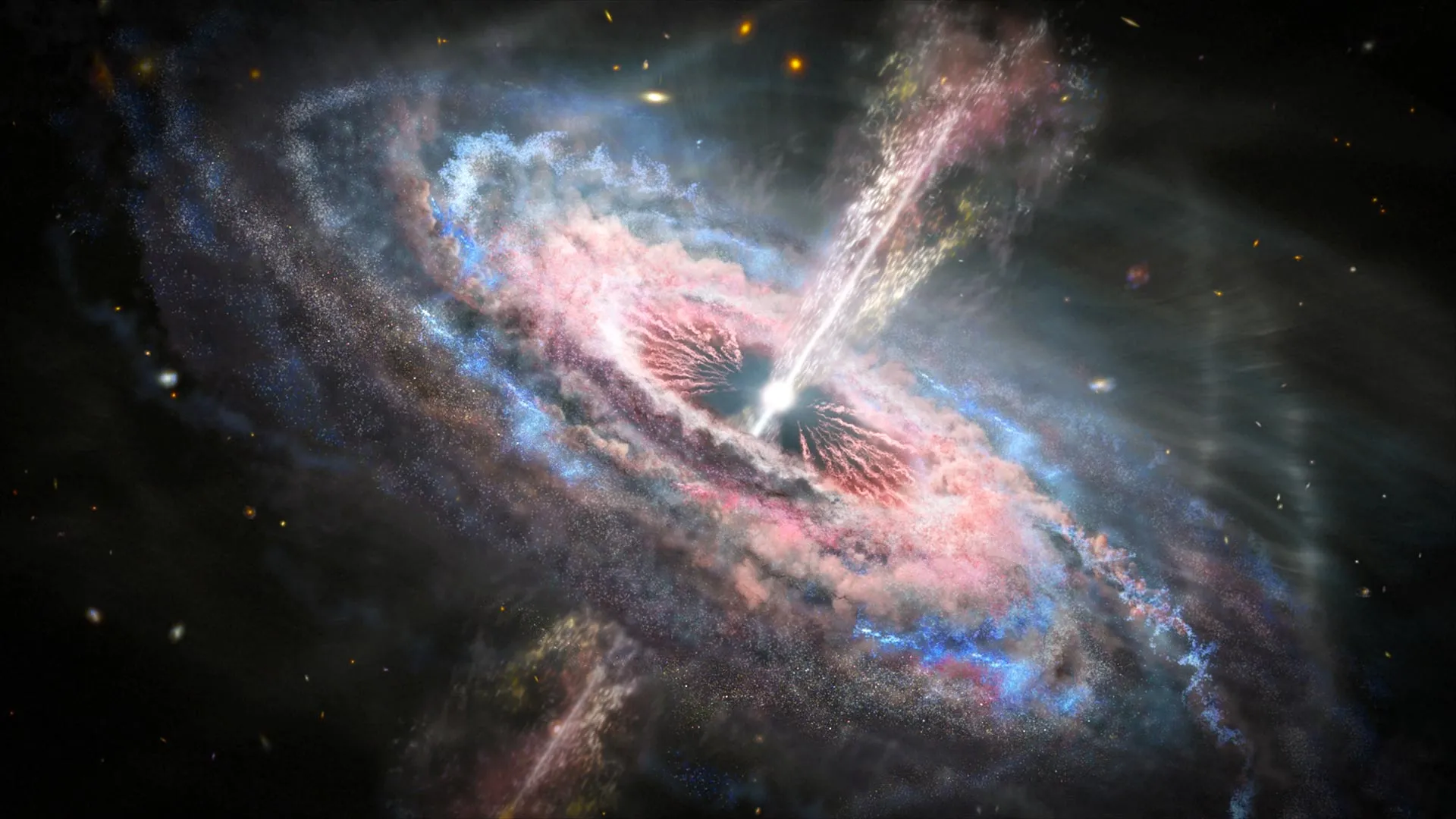
Astronomers have discovered 31 of the universe's oldest known quasars, two of which rank as the earliest ever detected. These quasars blazed into existence when the universe was merely 670 million years old, according to observations published recently in peer-reviewed research.
Quasars are extraordinarily luminous objects powered by supermassive black holes containing billions of solar masses. The newly discovered quasars' existence poses a fundamental puzzle for cosmology. Current models of black hole formation predict that such massive objects require far longer than 670 million years to assemble, yet these ancient specimens challenge that timeline directly.
The discovery emerged from systematic searches through archival data and targeted observations of the early universe. Astronomers identified the quasars through their distinctive spectral signatures and redshift measurements, confirming their extreme distances and ages. The most ancient examples existed less than 5 percent of the universe's current age.
The existence of these supermassive black holes so early in cosmic history raises urgent questions about formation mechanisms. Standard theory suggests black holes grow through accretion of surrounding material and mergers with other black holes, processes that accumulate mass gradually over billions of years. Yet these observations indicate that supermassive black holes somehow reached billions of solar masses in just hundreds of millions of years.
Several proposed explanations are under investigation. Some researchers suggest the early universe contained conditions that accelerated black hole growth beyond current model predictions. Others propose that primordial black holes formed in the Big Bang's immediate aftermath with substantial initial masses. Still others hypothesize that the accretion process operated far more efficiently in the early universe's dense environment.
The findings carry implications across multiple research domains, from black hole physics to galaxy formation. Early supermassive black holes likely influenced surrounding star formation and galaxy development through powerful jets and radiation. Understanding their origins constrains models of the universe's first billion