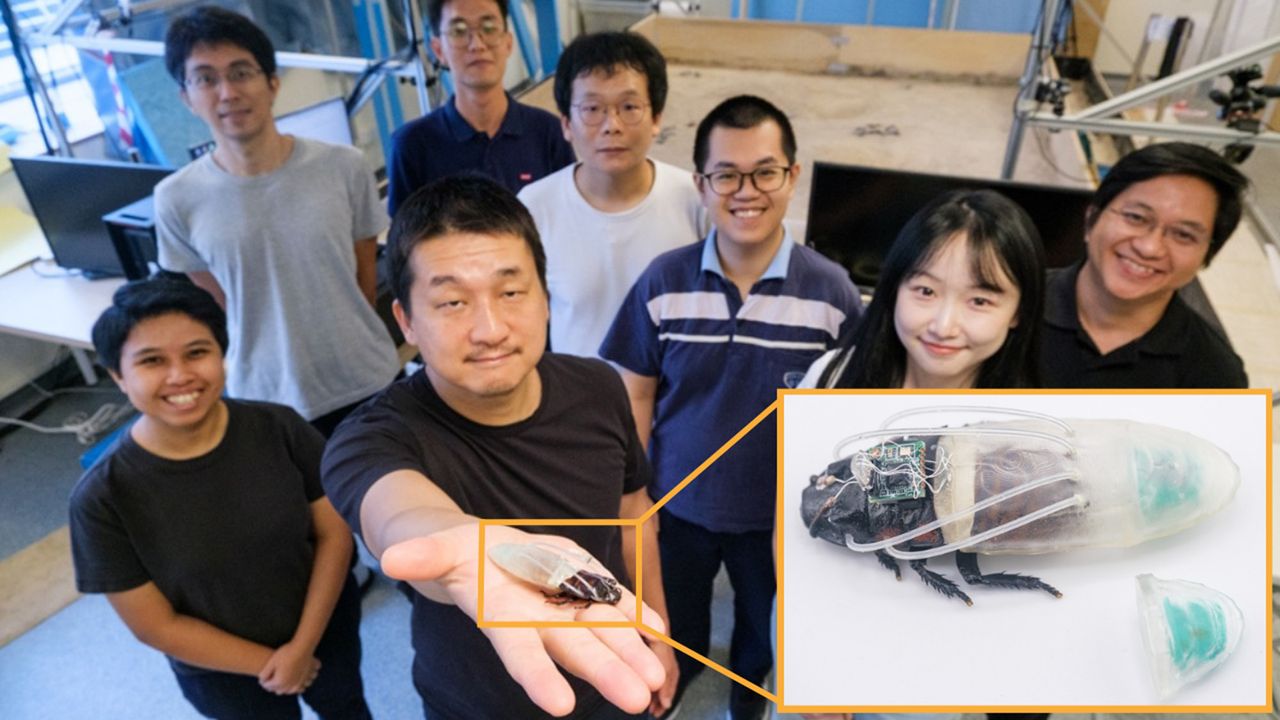
Researchers at Nanyang Technological University in Singapore and collaborating institutions in Japan have engineered a lightweight waterproof exoskeleton for cockroaches, creating aquatic search-and-rescue cyborgs capable of exploring disaster zones.
The team designed a fitted polymer shell that attaches to each insect's body, enabling the arthropods to survive submersion in water for extended periods. Cockroaches serve as ideal candidates for this application because they already possess exceptional navigational abilities, can squeeze through narrow gaps, and tolerate extreme environmental conditions.
The waterproof coating prevents water from entering the insects' spiracles, the breathing openings along their bodies that normally allow gas exchange with air. By maintaining a protective barrier while preserving the cockroach's natural mobility, researchers created a hybrid system combining biological locomotion with engineered enhancement.
This innovation addresses a critical gap in disaster response. During earthquakes, tsunamis, or floods, search teams struggle to locate survivors in submerged rubble and confined spaces. Deploying thousands of cyborg cockroaches equipped with miniaturized sensors could map flooded environments, detect chemical signatures of human presence, and relay location data to rescue teams in real time.
The insects retain their natural problem-solving capabilities and require minimal energy compared to traditional robotic alternatives. A single cockroach can operate autonomously for hours, navigating obstacles while transmitting information wirelessly.
Limitations remain significant. The current prototype requires further refinement to ensure long-term waterproofing under varying pressure and temperature conditions. Developing reliable micro-sensors and wireless systems compact enough for insect-scale deployment demands continued engineering advancement. Ethical considerations around using living organisms for potentially dangerous missions also merit discussion.
The research represents convergence between biomimetic engineering and disaster response innovation. Rather than replacing biological systems, the team enhanced them strategically. This approach leverages evolution's