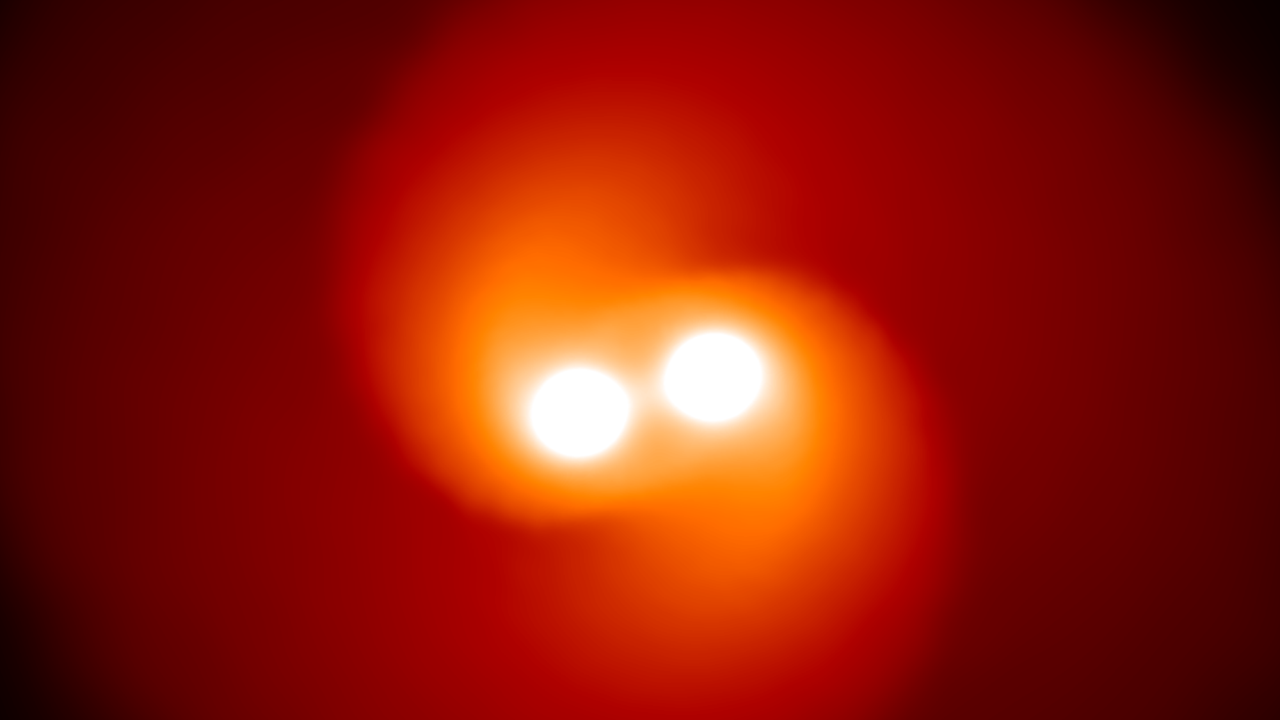
Researchers have identified a new mechanism for interacting supernovae, a class of cosmic explosions that occur when binary stars engage in a fatal orbital dance before one detonates.
In these systems, two stars orbit closely together. As one star ages and expands into a red giant, it begins transferring material onto its companion through a process called mass transfer. This stolen gas accumulates on the surface of the smaller star until conditions become extreme enough to trigger thermonuclear explosion.
The discovery addresses a long-standing puzzle in astrophysics. Traditional models predicted that interacting supernovae should behave in specific ways, but observations revealed a broader range of explosion properties than theory could explain. The binary star interaction mechanism now accounts for this diversity.
Astronomers studying these systems found that the dynamics of mass transfer significantly alter how the explosion unfolds. The companion star's influence on where and how hydrogen-rich material accumulates changes the supernova's brightness, spectrum, and expansion velocity. Some explosions appear fainter or brighter than expected depending on the exact configuration of the binary system.
This research matters because interacting supernovae serve as cosmic distance markers. Astronomers use their brightness patterns to map the expansion history of the universe and refine measurements of dark energy. Inaccurate models of these explosions introduce systematic errors into those measurements.
The findings also illuminate stellar evolution. Most massive stars exist in binary systems, yet their interaction and ultimate fate remain incompletely understood. Studying how close companions influence supernovae provides direct observational tests of binary evolution theory.
The work builds on decades of supernova observations but synthesizes them into a coherent framework. Modern telescopes and spectroscopic techniques now reveal enough detail about individual explosions to distinguish between competing theoretical models.
Future observations from space-based and ground-based observatories will test these predictions further. Systems like the Vera