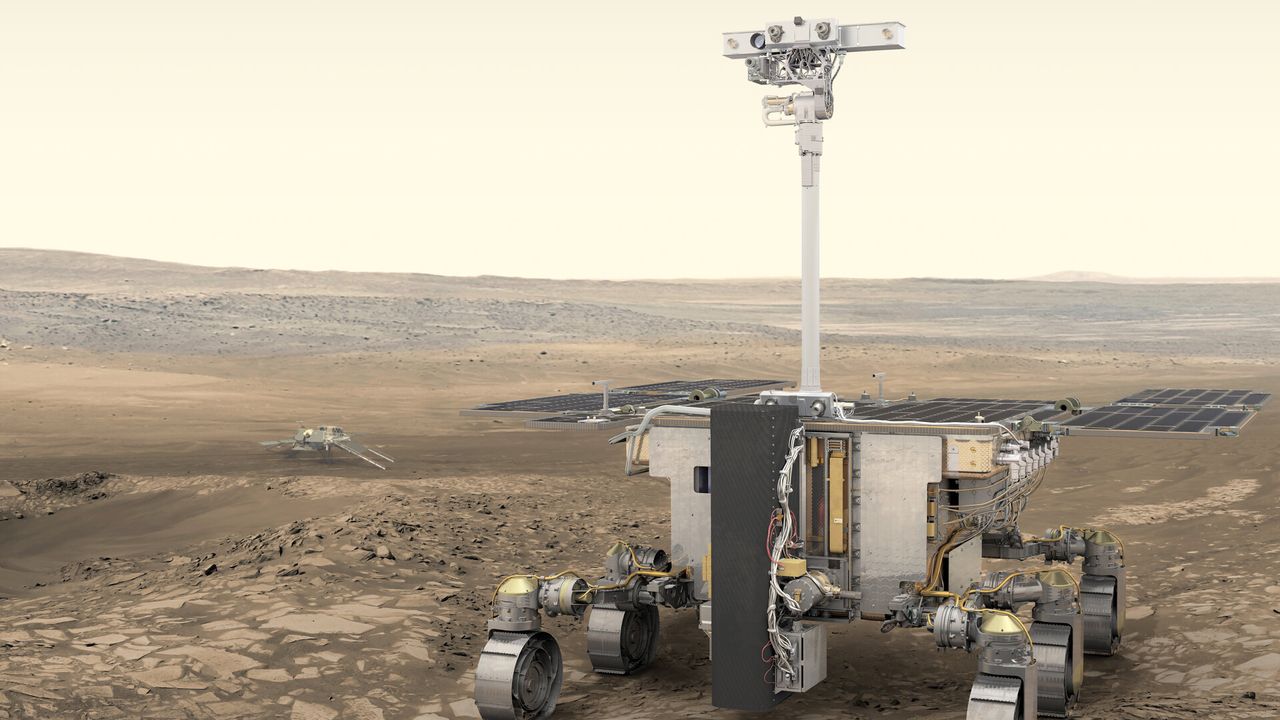
The European Space Agency's Rosalind Franklin rover will drill deeper into Mars than any mission before it, targeting clay-rich regions where ancient microbial life might have left fossilized traces. The rover operates as part of the ExoMars program, a joint effort between ESA and Russia's space agency Roscosmos.
Clay minerals form in water, making them ideal preservation environments for organic molecules and potential biosignatures. The rover's primary tool is a drill capable of penetrating up to two meters below the Martian surface, far exceeding the shallow sampling depths of previous rovers like Curiosity and Perseverance. This depth matters because subsurface material remains shielded from Mars's harsh radiation, which degrades organic compounds over time.
The Rosalind Franklin rover carries an onboard laboratory called PASTEUR that analyzes drilled samples for signs of ancient life. The instrument suite includes a gas chromatograph and mass spectrometer, allowing scientists to detect organic compounds and study their chemical structure. The rover also features a Raman spectrometer that can identify minerals and organic molecules without destroying samples.
Researchers selected clay-bearing sites based on orbital data showing evidence of water interaction billions of years ago. Jezero Crater, where NASA's Perseverance rover currently operates, ranks among the prime candidates. Clays there formed during Mars's wet period roughly 3.8 to 3.5 billion years ago.
The mission addresses a fundamental astrobiology question: Did life emerge on Mars during its habitable past? If microorganisms existed, clay minerals would have entombed them, preserving complex organic compounds and potentially recognizable fossil structures. This preservation advantage sets clay investigation apart from searching rocks or regolith at the surface.
Previous missions found organic molecules in Martian rocks, but scientists could not determine whether they originated from living organisms