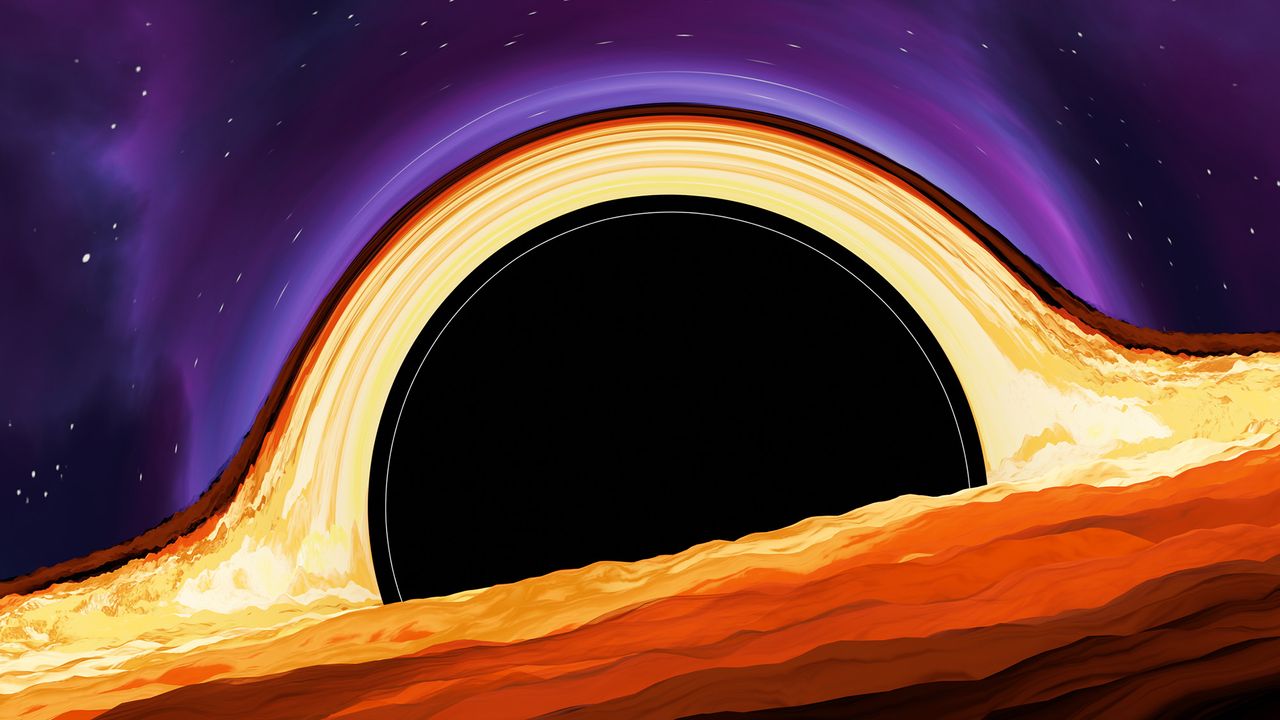
Physicists have detected gravitational waves emanating directly from a black hole's event horizon, capturing what researchers describe as the "last sound" of a collision between two massive black holes. This observation provides the first direct evidence of gravitational wave signals originating from the immediate vicinity of an event horizon, the point of no return surrounding a black hole.
The detection relied on data from the Laser Interferometer Gravitational-Wave Observatory (LIGO) and the Virgo gravitational wave detector. Researchers analyzed signals from black hole mergers, isolating high-frequency oscillations that match theoretical predictions for waves generated near the event horizon itself. These oscillations occur during the final moments of collision, when the merged black hole "rings down" as it settles into a stable state.
The significance lies in accessing a region previously invisible to direct observation. Event horizons represent the extreme physics boundary where general relativity reaches its limits. By detecting these waves, scientists gain empirical access to that boundary layer in ways traditional astronomy cannot provide.
The research builds on work published in recent years examining the ringdown phase of black hole mergers. Previous analyses focused on the merger itself. This new work specifically isolates the high-frequency tail of that signal, which corresponds to vibrations of the newly formed black hole's event horizon. The frequencies detected align precisely with predictions from Einstein's general relativity.
This discovery opens pathways to test whether black holes behave exactly as Einstein's theory predicts, particularly in extreme conditions. Deviations from theoretical predictions could hint at undiscovered physics operating near event horizons. With upcoming upgrades to LIGO and construction of next-generation detectors like the Einstein Telescope and Cosmic Explorer, scientists expect to detect these signals with increasing frequency and clarity.
The work demonstrates that gravitational wave astronomy has matured beyond simply confirming mergers happen. Researchers can now examine the detailed physics