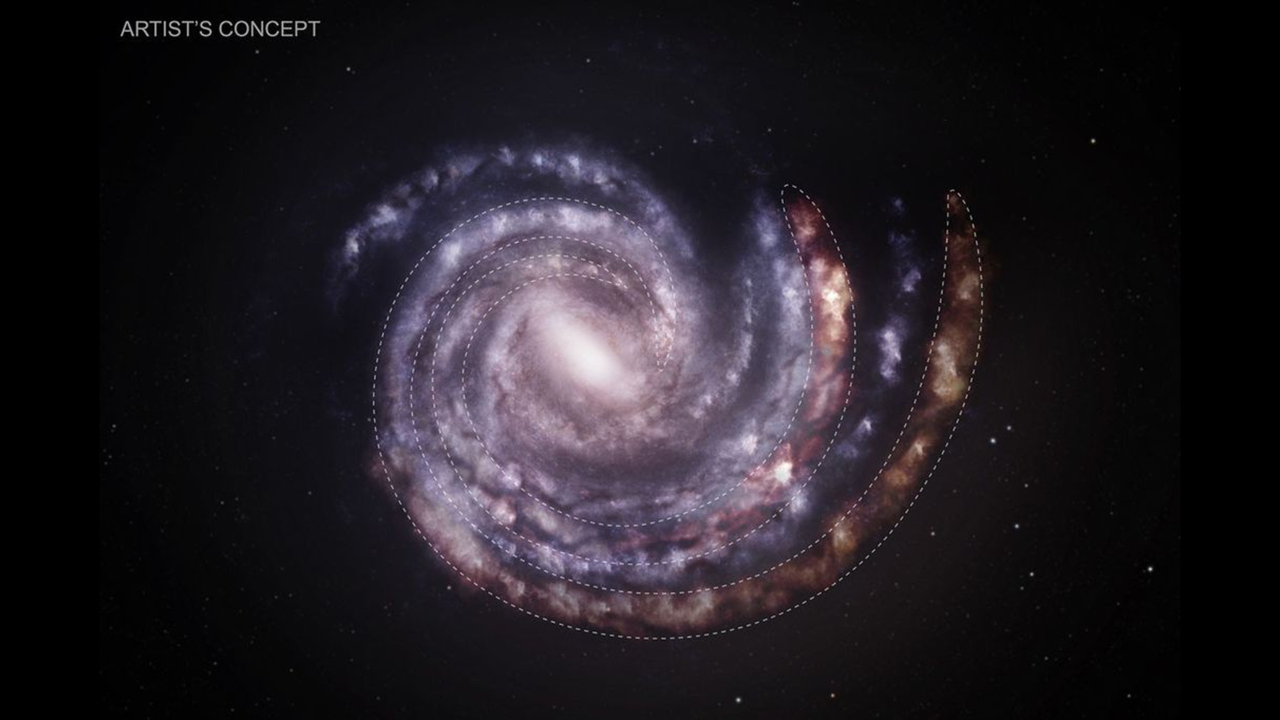
Astronomers have discovered that the Milky Way galaxy extends farther into space than previous measurements indicated. Researchers used type Ia supernovae, cosmic explosions of white dwarf stars, as distance markers to recalibrate measurements of our galaxy's size.
Type Ia supernovae occur in binary star systems where a white dwarf pulls material from a companion star until a thermonuclear explosion happens. These explosions reach a consistent peak brightness, making them reliable "standard candles" for measuring distances across the universe. By observing supernovae in nearby galaxies and comparing their brightness to known distances, astronomers calibrated a more accurate scale for cosmic measurements.
The team applied this refined calibration to existing data about our own galaxy, revealing that the Milky Way's stellar disk extends farther outward than astronomers previously calculated. The galaxy's true dimensions reshape our understanding of its mass distribution and structure.
This finding carries implications for galactic dynamics and dark matter distribution. A larger galaxy means its stars occupy more volume, which affects calculations about orbital velocities and the gravitational forces at play. The extended size also influences estimates of how much dark matter surrounds our galaxy's visible components.
The research builds on decades of work mapping the Milky Way's structure. Ground-based telescopes and space observatories like Gaia have provided increasingly detailed three-dimensional maps of star positions and movements. However, determining absolute distances remains challenging. Type Ia supernovae offer a complementary method to other distance-measurement techniques like parallax measurements and variable star observations.
Understanding the Milky Way's true extent matters for placing Earth in cosmic context. It also provides a reference point for comparing our galaxy to other spiral galaxies observed in the universe. The findings underscore how astronomers continue refining fundamental knowledge about our home galaxy through new measurement techniques and careful analysis of existing observations.