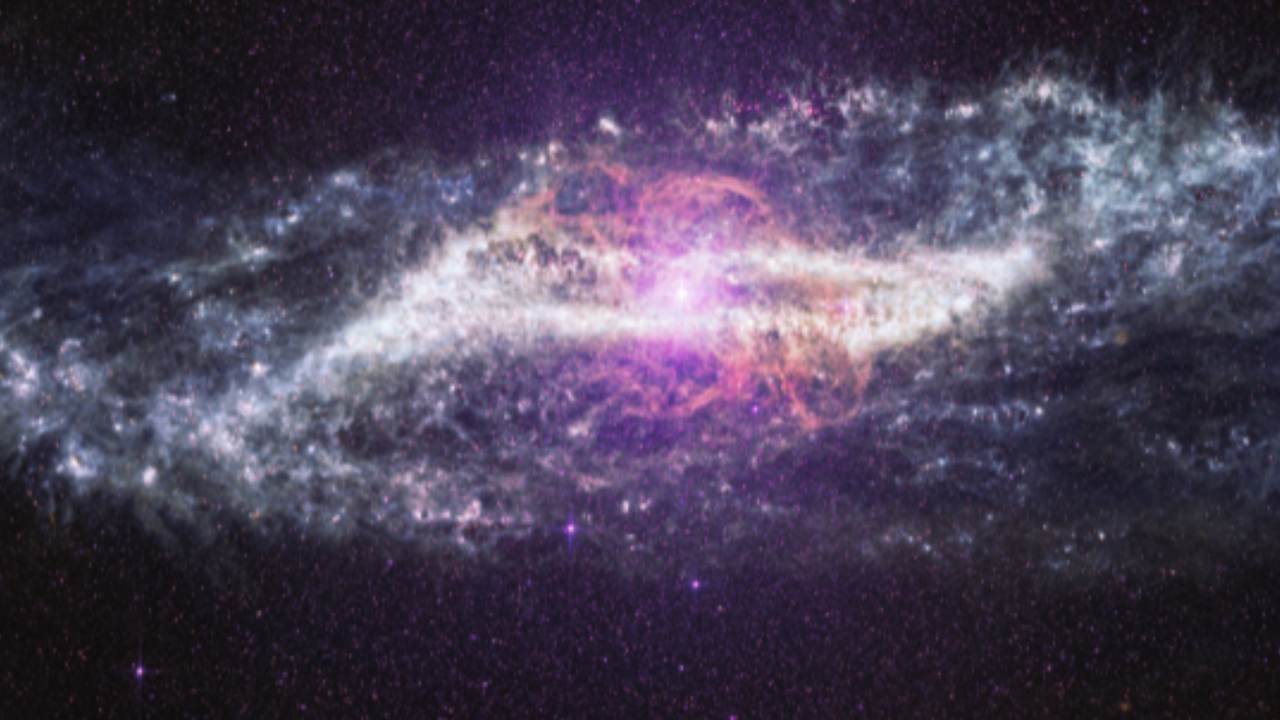
NASA released a striking image of Centaurus A to mark the James Webb Space Telescope's fourth anniversary of operations. The image captures the aftermath of a galactic collision that occurred roughly 2 billion years ago.
Centaurus A stands out as one of the nearest active galaxies to Earth, located approximately 12 million light-years away. The galaxy's distorted shape and unusual structure result directly from its violent merger with another galaxy in the distant past. This cosmic crash fundamentally reshaped the galaxy, leaving visible scars across its form that James Webb's infrared sensors can now detect with unprecedented clarity.
The fourth-year milestone underscores the telescope's continued success since its December 2021 launch. James Webb observes primarily in the infrared spectrum, allowing it to peer through dust clouds that block visible light and reveal structures hidden from traditional optical telescopes. This capability proves especially valuable when studying galactic collisions, where dust obscures much of the action occurring within merging systems.
Centaurus A's dramatic morphology makes it an ideal target for demonstrating Webb's observational power. The galaxy displays a prominent dust lane bisecting its bright central region, along with extended jets of material streaming outward from its active supermassive black hole. These jets extend hundreds of thousands of light-years into space, powered by the energy released from matter spiraling into the black hole at the galaxy's core.
The image released for the anniversary celebration showcases Webb's ability to capture fine details across vast cosmic distances. By observing Centaurus A in infrared light, the telescope reveals the distribution of stars, dust, and warm gas throughout the galaxy far more clearly than visible-light observations allow.
NASA uses milestone anniversaries to highlight the telescope's scientific achievements and demonstrate its ongoing contributions to astronomy. Each new image released adds to humanity's understanding of how galaxies form, merge, and evolve across cosmic