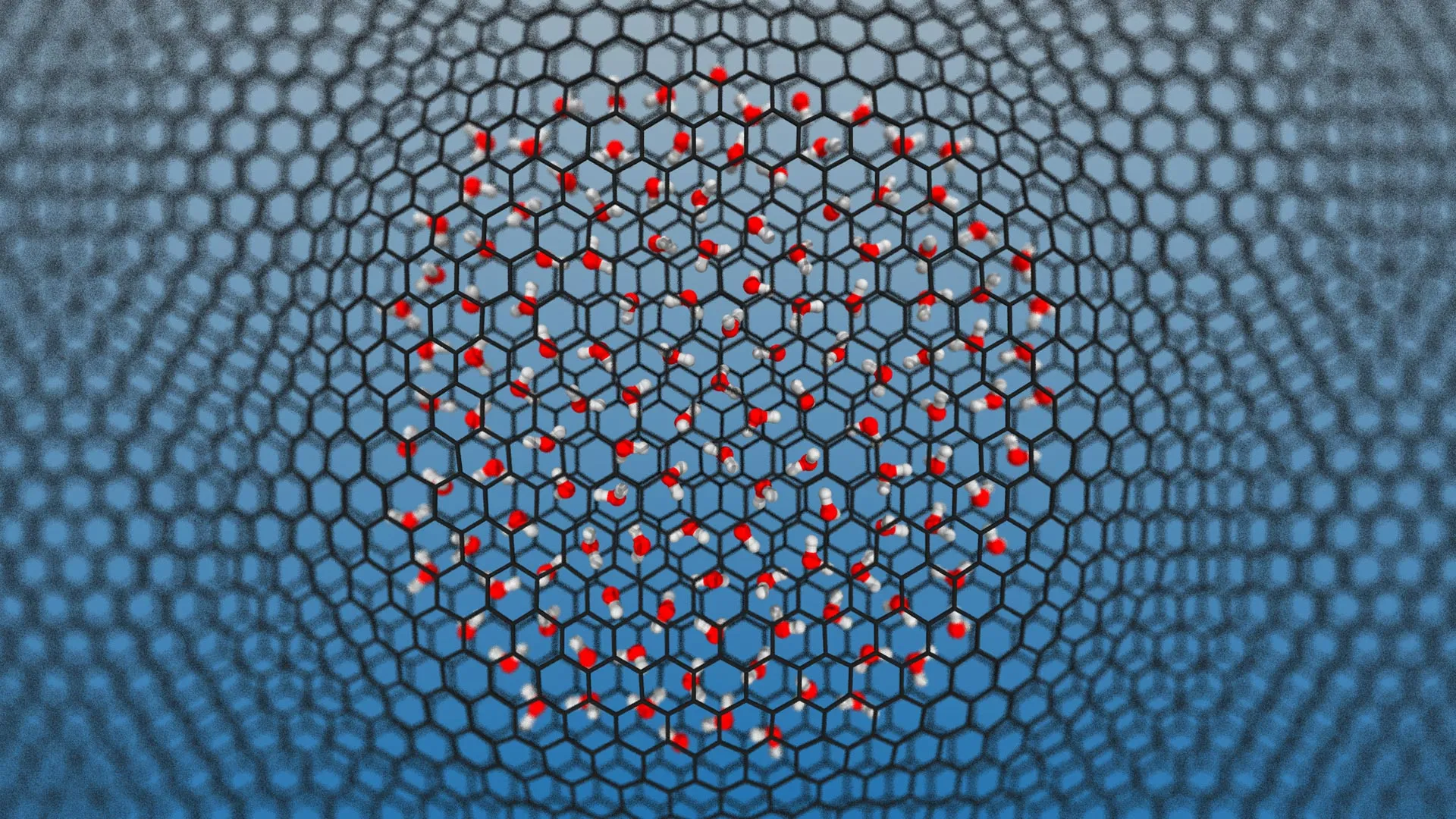
Researchers have solved a long-standing mystery about water's behavior in nanoscale spaces, overturning assumptions held for decades. The team found that water confined in tiny gaps does not become inherently more chemically reactive simply because of its confinement. Rather, the extreme pressures generated within these microscopic environments account for the observed reactivity changes.
The study reveals a two-part mechanism. First, the physical compression inside nanoscale spaces raises pressure to levels that alter water's chemical properties. Second, the material surrounding these spaces can amplify water's reactivity if it chemically interacts with the products of water-based reactions. This distinction matters because it reframes how scientists understand confined water systems.
The findings have practical implications across multiple fields. Nanoscale water appears in geological formations, industrial catalysis, battery technology, and biological systems including cell membranes. Understanding what drives reactivity in these confined environments allows researchers to better predict and control chemical behavior in applications ranging from energy storage to environmental remediation.
Previous work had suggested that confinement itself somehow enhanced water's intrinsic reactivity, but this research demonstrates that interpretation was incomplete. The pressure effect dominates the phenomenon. The material properties surrounding the water matter, but primarily through chemical interactions with reaction byproducts rather than through mysterious effects of confinement alone.
The team used experimental and theoretical approaches to isolate these mechanisms. By carefully measuring reactivity under controlled conditions and modeling the pressures involved, they could determine which factors drove the observed chemical changes. This methodical approach allowed them to distinguish between pressure effects and material interactions.
These results refine how scientists think about water in extreme environments. The work suggests that engineers designing nanoscale systems can now predict water reactivity more accurately by calculating internal pressures and considering potential reactions between water and surrounding materials. Future research may explore whether this pressure-dominated mechanism applies to other confined fluids or chemical systems