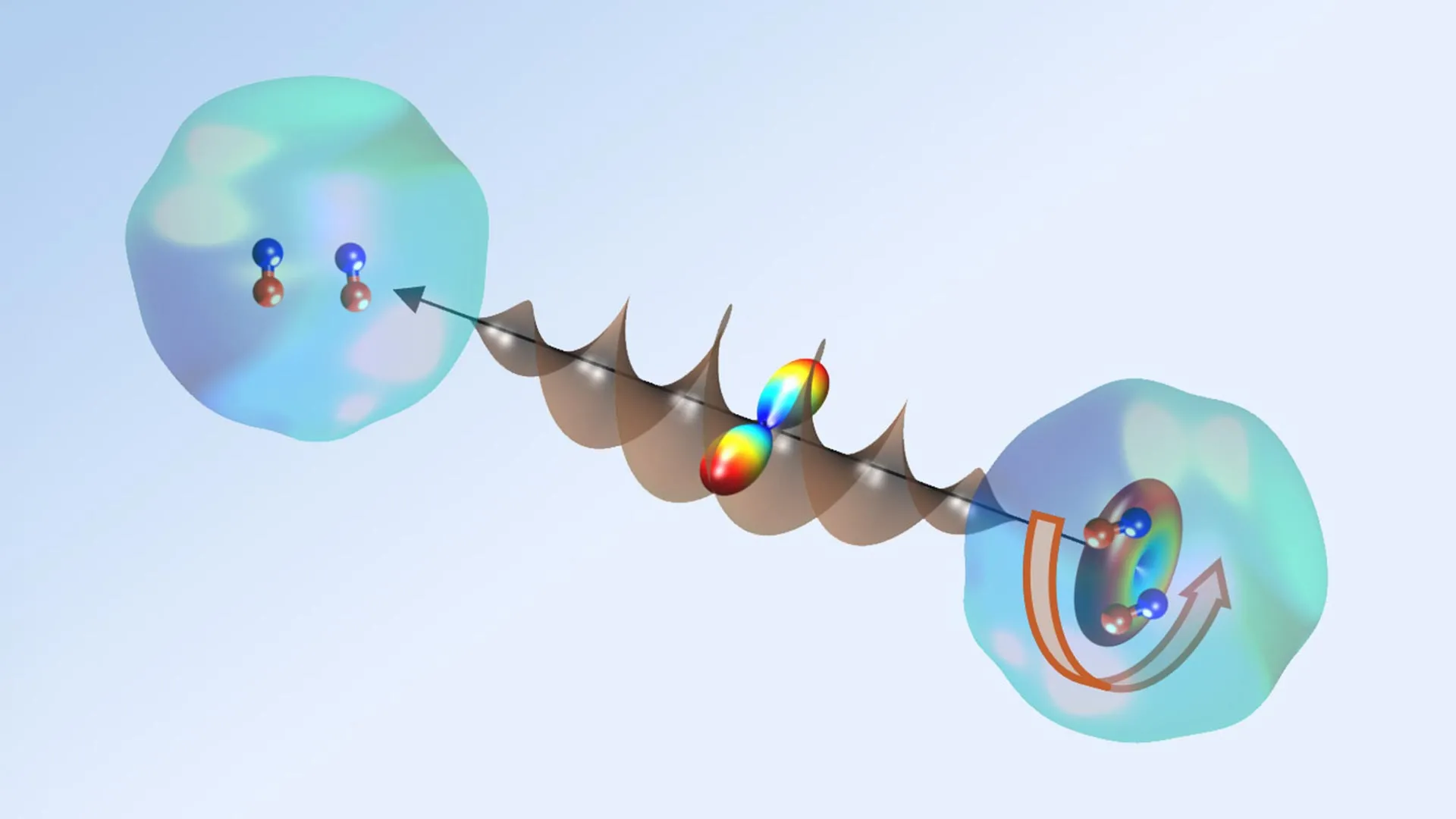
Physicists have created an optical centrifuge capable of spinning individual molecules inside a superfluid, opening a new window into how these exotic quantum liquids behave. The technique uses precisely controlled laser beams to rotate molecules without friction, allowing researchers to probe the mechanical properties of superfluids at scales previously inaccessible to experiments.
Superfluids, such as liquid helium cooled below 2.17 Kelvin, possess zero viscosity and can flow without resistance. They represent one of quantum mechanics most counterintuitive phenomena, yet fundamental questions remain about how their frictionless properties emerge and eventually collapse at extreme conditions. The new optical centrifuge addresses this knowledge gap by enabling direct observation of molecular rotation within the superfluid environment.
The device works by trapping molecules with intersecting laser beams arranged in a precise pattern. As the researchers vary the laser configuration, they rotate the trapped molecules at controlled speeds, essentially creating a spinning trap. By measuring how molecules behave under rotation, scientists can detect when the superfluid's frictionless properties break down and drag begins to emerge.
This capability matters because it lets researchers test theoretical predictions about superfluidity directly. Current models suggest that at sufficiently high rotation rates, quantized vortices form within the superfluid, structures that dissipate energy and destroy the frictionless state. Observing this transition at the molecular scale could confirm or refine existing quantum theories and improve understanding of how macroscopic quantum phenomena arise from microscopic interactions.
The advance also has practical implications. Better understanding of superfluids could enhance precision instruments like atomic clocks and sensors that exploit quantum properties. Additionally, insights into how superfluidity breaks down might inform research into other quantum states of matter and topological phenomena.
The work represents a technical achievement in laser manipulation and detection sensitivity. Creating stable optical traps capable of rotating molecules while maintaining measurements precise enough