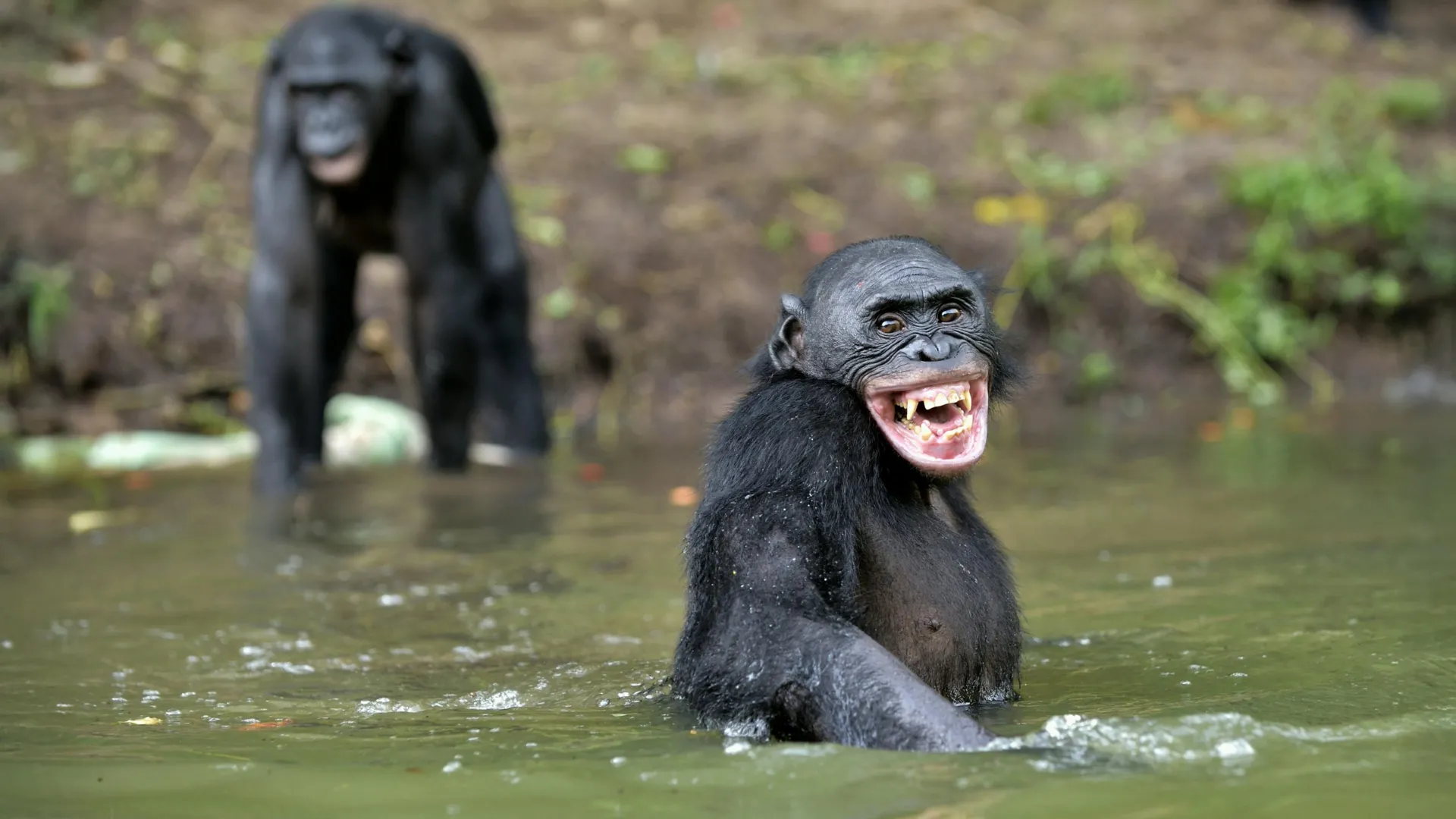
Researchers examining laughter across great apes have uncovered rhythmic patterns that connect human speech evolution to our primate ancestors. The study reveals that the fundamental timing and cadence of laughter remains consistent across humans, chimpanzees, bonobos, gorillas, and orangutans, suggesting this behavior originated millions of years ago before these species diverged.
Human laughter operates with a regular beat, roughly every 75 to 80 milliseconds. Scientists discovered comparable rhythmic structures in great ape vocalizations, indicating the timing mechanism evolved before modern humans existed. This regularity requires precise control over breathing and vocal cord vibration, the same muscular coordination that enables speech.
The research points to a critical insight: the vocal apparatus humans use for language likely developed from mechanisms originally designed for emotional expression and social bonding. Laughter serves this social function across all great apes. The rhythmic control needed to produce regular bursts of laughter would have primed the evolutionary stage for finer vocal manipulation, eventually enabling consonants, vowels, and complex speech.
This discovery addresses a longstanding puzzle in human evolution. Speech requires exceptional motor control over breathing, throat, and mouth muscles in coordinated timing. Rather than emerging suddenly, this capability apparently built on existing infrastructure for producing rhythmic vocalizations. Laughter provided the evolutionary scaffolding.
The findings come from comparative analysis of vocalizations recorded across multiple ape species. By measuring acoustic properties and temporal patterns, researchers documented the universal rhythmic structure. Some variation exists between species and individuals, but the underlying beat persists.
The research has limitations. Laughter alone does not explain the full complexity of human speech, which involves semantic meaning, grammar, and abstract thought. However, the vocal control mechanisms underlying rhythmic laughter represent a tangible evolutionary bridge between primate emotion and human language. This connection illuminates how natural selection could favor increasingly