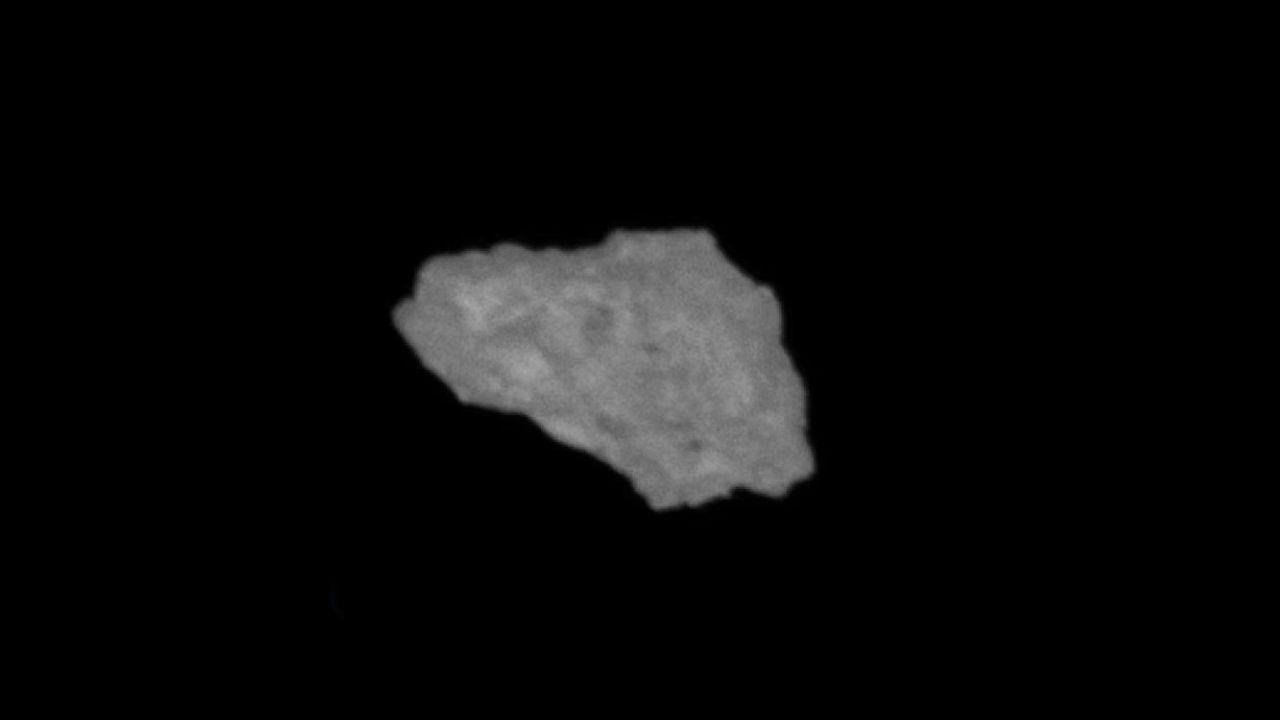
China's Tianwen-2 spacecraft has transmitted the first photograph of asteroid 2016 HO3, a celestial body known as Kamo'oalewa, from proximity. The image marks a milestone in humanity's observation of this elusive object that orbits Earth in an unusual pattern.
Kamo'oalewa, a Hawaiian name meaning "the offspring of the distant star," describes an asteroid that maintains a quasi-lunar relationship with Earth. Unlike conventional moons, it does not orbit Earth directly. Instead, the asteroid traces a horseshoe-shaped path relative to our planet, coming closer and drifting farther in a complex gravitational dance. This distinctive orbital behavior makes it an object of scientific interest for researchers studying near-Earth asteroids and planetary dynamics.
The Tianwen-2 mission represents China's focused effort to study this unusual asteroid. By capturing direct imagery of Kamo'oalewa, the probe provides unprecedented data about the object's physical characteristics, surface features, and composition. Such observations could reveal information about the asteroid's formation history and material composition, contributing to broader understanding of the solar system's small bodies.
Scientists have long struggled to obtain detailed information about 2016 HO3 because of its distance and orbital peculiarities. The quasi-moon moves between approximately 38 and 100 times farther from Earth than the Moon orbits, making ground-based observation difficult. Space-based telescopes have provided limited views, making direct spacecraft imagery invaluable for planetary science.
The successful transmission of imagery from Tianwen-2 demonstrates China's advancing capabilities in deep space exploration and asteroid investigation. The mission contributes to the growing international interest in near-Earth objects, driven partly by concerns about planetary defense and partly by scientific curiosity about solar system formation.
Future observations from Tianwen-2 may yield additional insights into K