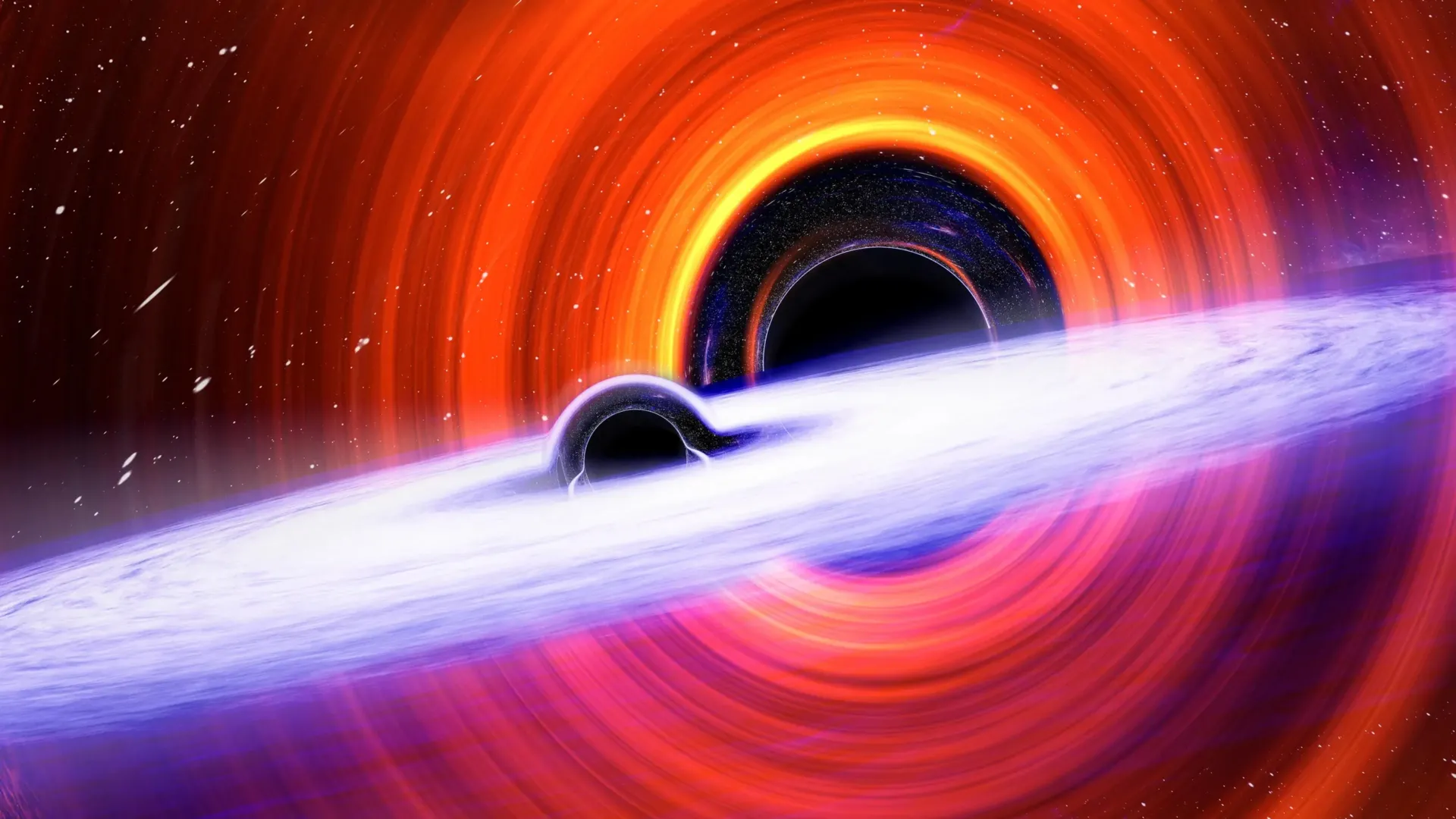
Researchers analyzing data from LIGO, the Laser Interferometer Gravitational-Wave Observatory, detected an anomalous gravitational wave signal that may provide evidence for primordial black holes. These hypothetical objects, formed in the early universe moments after the Big Bang, have long captivated theorists as potential dark matter candidates.
The signal stands out from typical black hole mergers detected by LIGO because of its unusual characteristics. Standard stellar black holes form from collapsed stars and display predictable properties. Primordial black holes would have formed under vastly different conditions in the extreme densities of the infant universe, potentially leaving distinctive signatures in gravitational waves.
Dark matter comprises roughly 85 percent of the universe's matter yet remains invisible to direct observation. Astronomers know it exists through its gravitational effects on galaxies and galaxy clusters. Finding its composition ranks among physics' most pressing unsolved problems. Primordial black holes, proposed decades ago, offer an elegant explanation. If they exist in sufficient numbers, they could account for dark matter's missing mass.
The LIGO discovery remains preliminary. The collaboration operates two gravitational-wave detectors in Louisiana and Washington state, observing ripples in spacetime caused by violent cosmic events. Each detection requires rigorous verification to rule out instrumental noise or statistical coincidences. Confirmation of primordial black holes would require multiple similar signals showing consistent patterns that distinguish them from known sources.
The significance extends beyond dark matter. Detecting primordial black holes would validate theoretical predictions about the early universe's properties and potentially reveal new physics. The extreme conditions required to form such objects could test fundamental assumptions about gravity and quantum mechanics.
Future gravitational-wave detectors, including the proposed Einstein Telescope and Cosmic Explorer, will observe fainter signals across broader frequency ranges. These upgrades could definitively answer whether primordial black holes populate the cosmos. Until