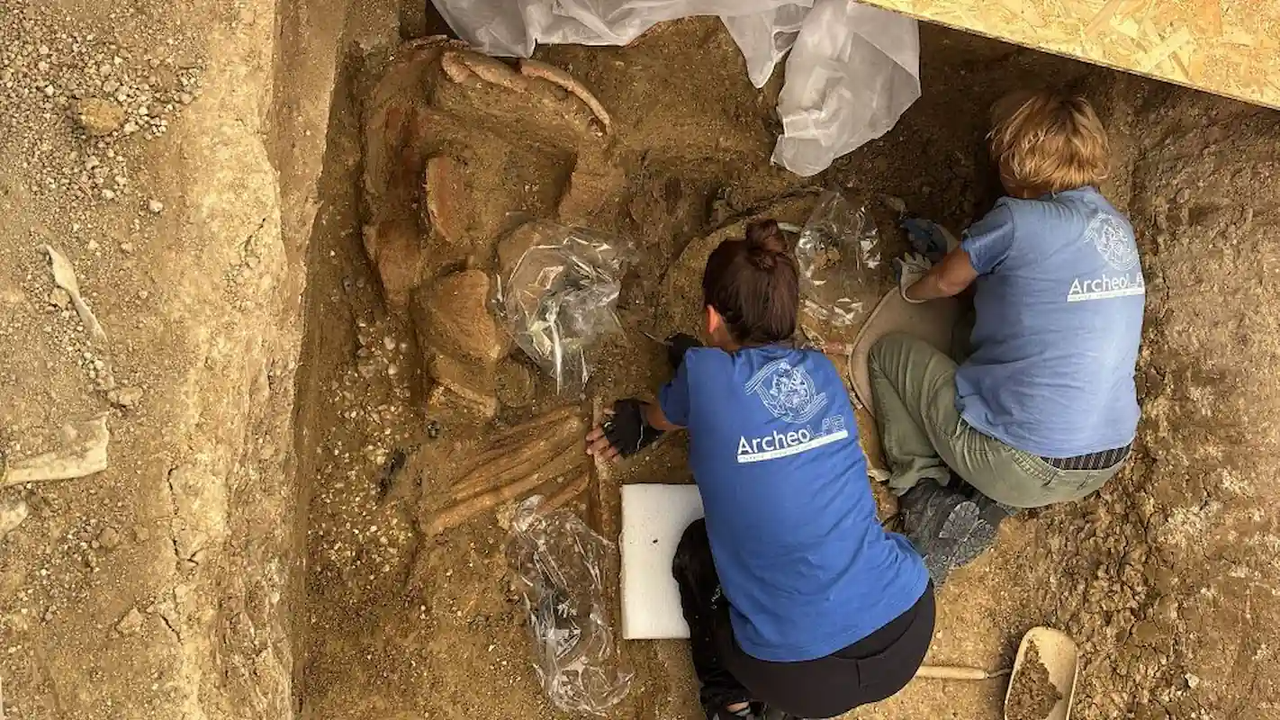
Archaeologists working along Italy's Adriatic coast have unearthed a 2,500-year-old tomb belonging to a Piceni warrior prince, complete with a chariot and helmet. The discovery provides rare insight into the Piceni, a pre-Roman civilization that remains poorly documented in historical records.
The Piceni occupied territories in central Italy during the Iron Age and early Classical period, roughly between the 9th and 1st centuries BCE. Despite their prominence in the region, historical accounts about them are sparse compared to better-documented civilizations like the Etruscans and Romans. This tomb represents a valuable window into their burial practices, social hierarchy, and material culture.
The excavation revealed significant grave goods positioned alongside the deceased warrior. The presence of a chariot indicates high social status, as such vehicles were luxury items reserved for elite members of society. The helmet provides evidence of the warrior's military role and suggests the importance of martial prowess in Piceni culture. Together, these artifacts offer archaeologists tangible evidence of how wealth and power were displayed and preserved in death.
The royal burial ground context amplifies the find's significance. Multiple tombs in the same location suggest this was a dedicated necropolis for the Piceni elite, potentially spanning generations. Such sites help archaeologists understand inheritance patterns, territorial control, and the evolution of political structures in pre-Roman Italy.
The discovery also contributes to broader knowledge of Italian Iron Age societies. The Piceni inhabited a strategic region between Etruscan lands to the west and Greek colonies to the south. Their material culture, influenced by these neighboring civilizations yet distinctly their own, reveals complex trade networks and cultural exchange in ancient Mediterranean societies.
The tomb's preservation allows researchers to date the burial through stratigraphic analysis and potentially radiocarbon dating of organic materials. Detailed documentation of artifact placement helps reconstruct funeral rituals