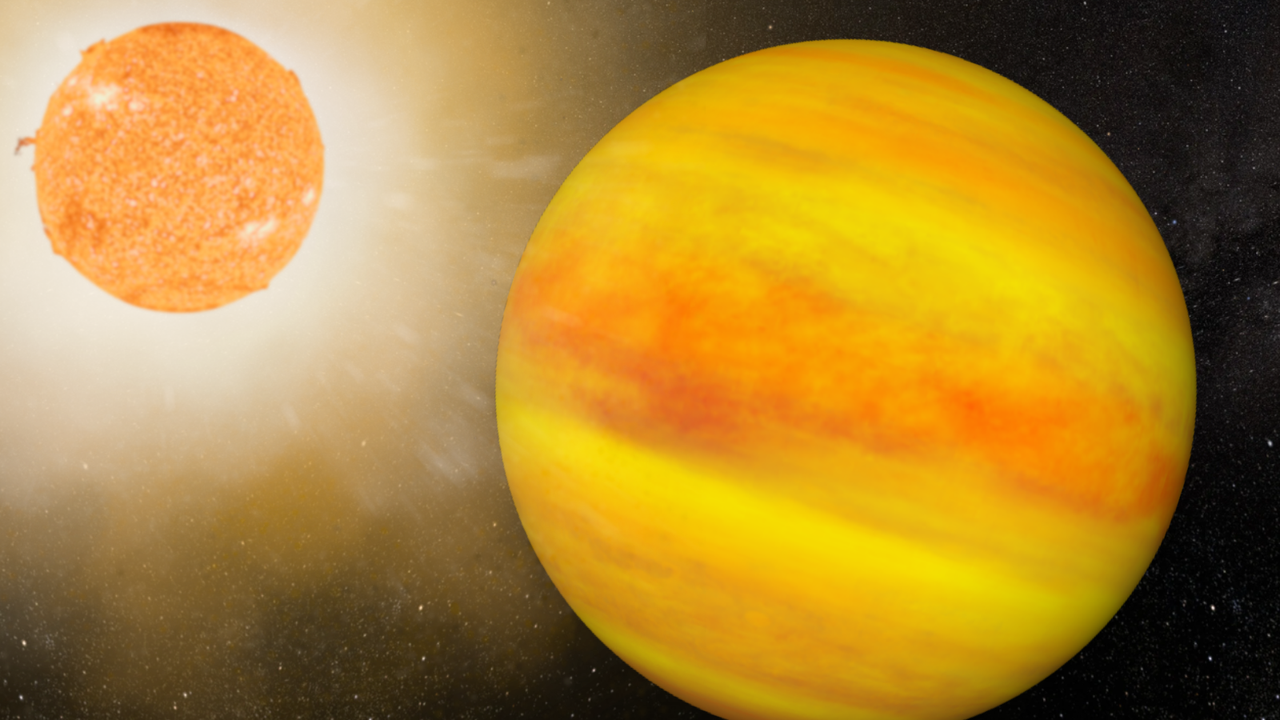
Astronomers have identified an unusual hot Jupiter whose thermal properties defy standard models of how these scorched gas giants should behave. The exoplanet exhibits a hotspot in an unexpected location, forcing researchers to reconsider fundamental assumptions about atmospheric circulation in these extreme worlds.
Hot Jupiters represent some of the most violent planetary environments known. These gas giants orbit extremely close to their host stars, experiencing stellar radiation thousands of times more intense than Earth receives from the sun. Their day-side temperatures often exceed 1,500 Kelvin. Standard atmospheric models predict these planets develop a single hotspot positioned on the hemisphere facing their star, offset slightly by planetary rotation and winds.
This newly discovered hot Jupiter breaks that pattern. Its hotspot appears displaced in ways that current circulation models cannot readily explain. The anomaly suggests either unknown atmospheric processes operate on these worlds or existing theoretical frameworks require substantial revision.
Researchers used infrared observations to map the planet's thermal distribution. Temperature variations across its surface revealed the unexpected hotspot location, prompting teams to analyze whether planet-specific characteristics like atmospheric composition, rotation rate, or magnetic field strength could account for the deviation.
The discovery underscores how much remains unknown about exoplanet atmospheres. While astronomers have characterized hundreds of hot Jupiters through transit spectroscopy and direct imaging, detailed thermal mapping of individual worlds remains challenging. Most characterization relies on indirect measurements or computational models tested against limited observational data.
Understanding this anomalous hot Jupiter requires follow-up observations from space telescopes like the James Webb Space Telescope and ground-based observatories. Detailed spectroscopy might reveal atmospheric composition variations that explain the unusual hotspot. Alternative hypotheses include unexpected cloud formations or asymmetric wind patterns that redirect heat away from the subsolar point.
Hot Jupiters themselves puzzled astronomers when first discovered decades ago. Theories initially predicted all