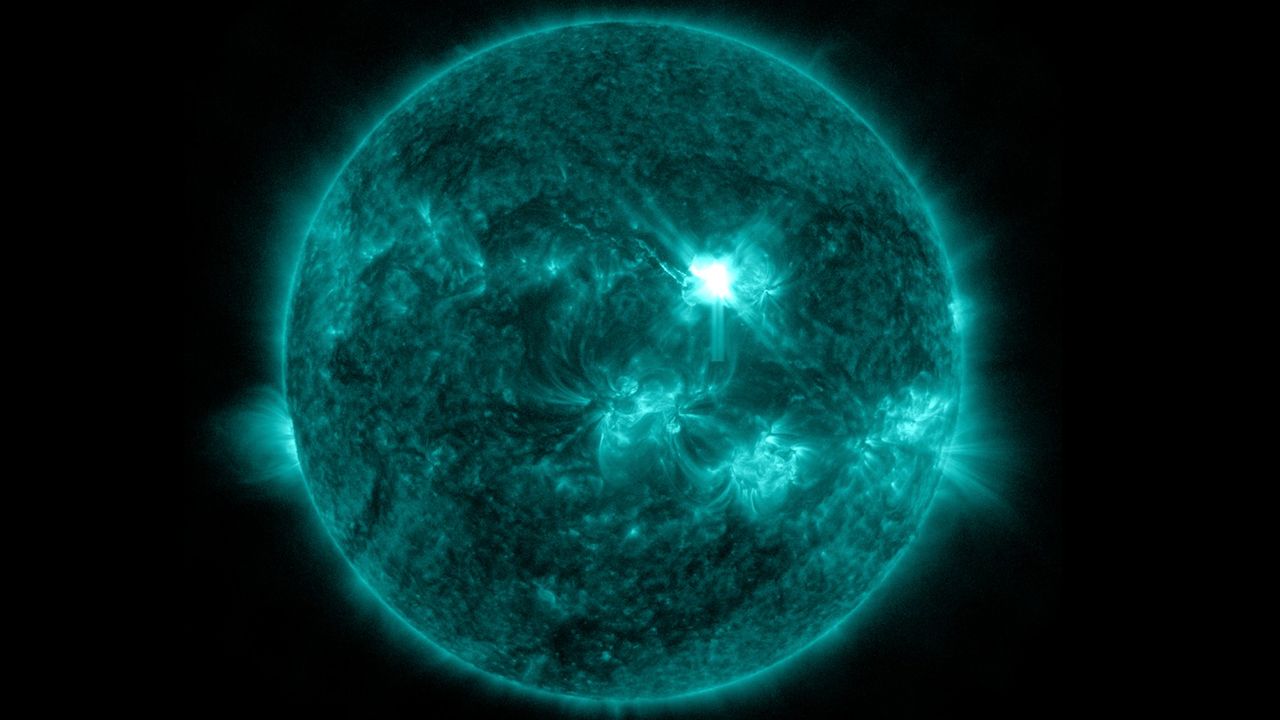
The sun erupted with an X1.1-class solar flare on July 2, temporarily disrupting radio communications across the sunlit side of Earth. The flare triggered a coronal mass ejection (CME) of charged particles that scientists predict will reach Earth's magnetosphere on July 3, potentially intensifying auroral displays over the northern latitudes during the July 4 weekend.
X-class flares rank among the sun's most powerful outbursts. The National Oceanic and Atmospheric Administration's Space Weather Prediction Center monitors these events continuously, as they can degrade high-frequency radio signals used in aviation and maritime navigation. The disruption from this particular flare proved brief, limiting operational impacts on communications systems.
The accompanying CME carries billions of tons of plasma and magnetic field material ejected from the solar corona. When these particles collide with Earth's magnetosphere, they compress and energize it, funneling charged particles into the upper atmosphere. This interaction produces the aurora borealis, the characteristic green and red curtains of light visible at high northern latitudes.
Forecasters issued a geomagnetic storm watch for July 3-4, with expectations ranging from G2 (moderate) to G3 (strong) geomagnetic activity on the Space Weather Prediction Center's five-point scale. The timing coincides with Independence Day celebrations across North America, creating an unusual opportunity for observers in Alaska, Canada, and the upper Midwest to witness auroral activity without dedicated astronomical travel.
The source region of this flare remains active on the solar disk, leaving open the possibility of additional eruptions in the coming days. Solar activity follows the sun's 11-year cycle, and the current cycle has entered an active phase with increasing flare frequency since 2020.
Ground-based magnetometers continuously track Earth's magnetic field response to solar events, allowing