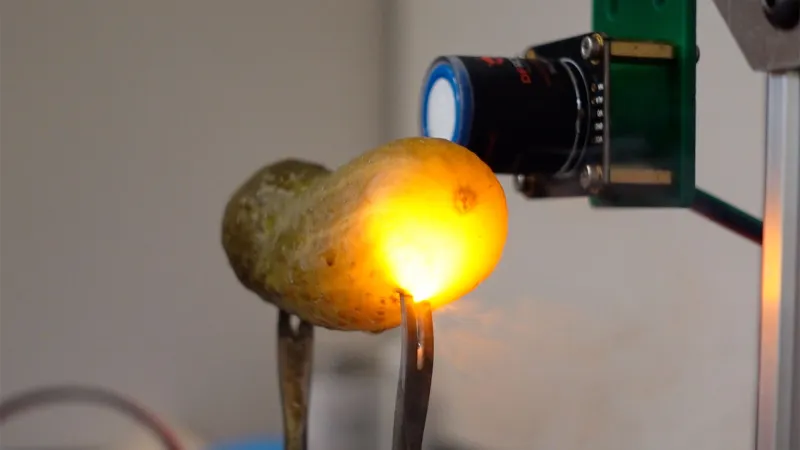
# Pickles Glow When Plugged In. Here's the Physics
Pickles emit a striking orange glow when connected to electrical current, a phenomenon rooted in basic plasma physics and the unique properties of salt-laden brine.
The glow occurs because pickles contain sodium ions from the salt used in brining. When high voltage passes through the pickle, these ions accelerate and collide with electrons, exciting them to higher energy states. As the electrons return to their baseline state, they release energy in the form of photons, creating visible light. The orange hue specifically comes from sodium's characteristic emission spectrum, the same wavelength that sodium vapor streetlights produce.
The pickle acts as a conductor suspended in conductive brine. The high electrical resistance of the pickle compared to surrounding moisture creates localized heating and ionization. This generates a plasma state within the pickle tissue, where gases become ionized and glow. The process differs from typical electrical conduction because the pickle's cellular structure, combined with its salt content, creates the conditions necessary for this dramatic light emission.
This demonstration works best with large pickles and substantial voltage, typically from household electrical outlets, though scientists emphasize this setup requires careful handling to avoid electrical hazards. The effect remains temporary, as the pickle rapidly heats and eventually chars from the current.
Beyond its role as a party trick, this phenomenon illustrates how electrical current interacts with conductive materials and ionized gases. Researchers use similar principles to study plasma behavior in laboratories. The pickle experiment makes visible the normally invisible processes occurring in neon signs, fluorescent bulbs and plasma displays, where electrical energy converts directly into light.
The experiment demonstrates that physics exists everywhere, even in your refrigerator. Food science collides with electrical science to produce an unexpected visual spectacle.