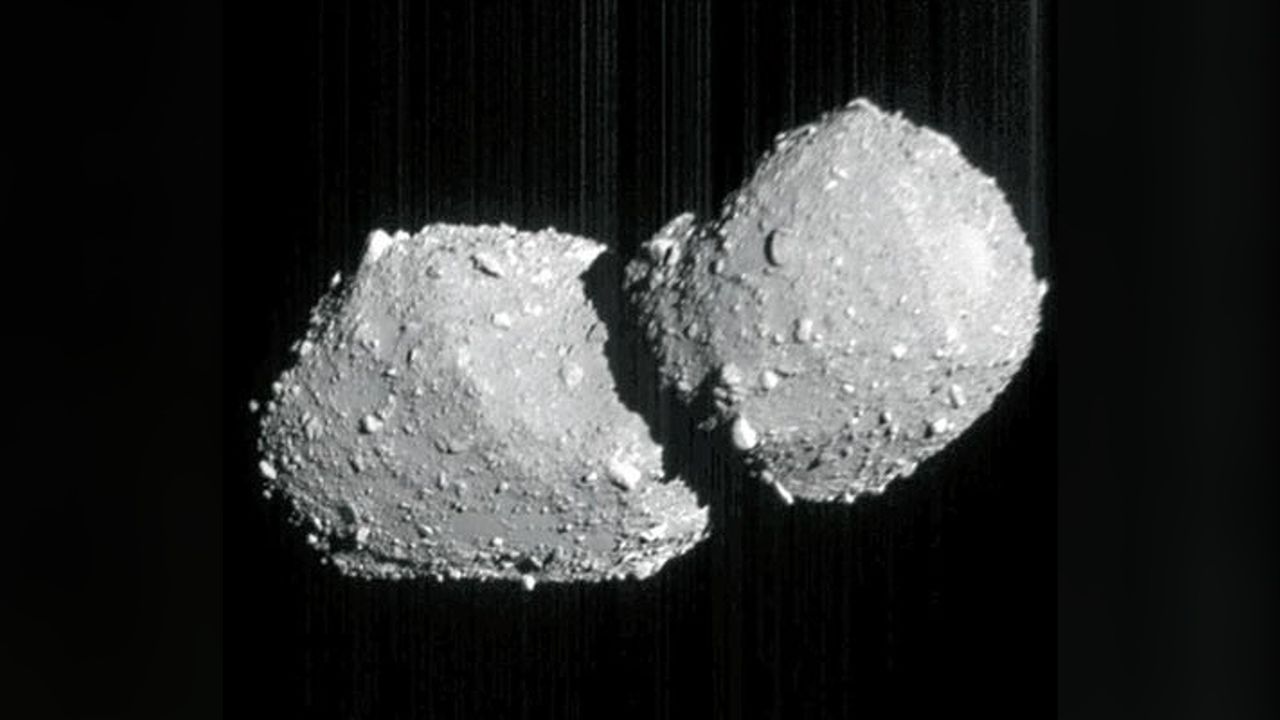
Japan's Hayabusa2 spacecraft captured detailed photographs of asteroid Torifune on July 5 from a distance of 62 million miles, revealing the binary structure of this celestial body. The images show the asteroid's distinctive double-lobed morphology, a characteristic common among near-Earth asteroids.
Hayabusa2, operated by the Japan Aerospace Exploration Agency (JAXA), conducted the flyby as part of its extended mission following its successful 2020 sample-return operation from asteroid Ryugu. The probe's optical instruments resolved Torifune's twin lobes with clarity, documenting features that inform scientists' understanding of asteroid formation and composition.
Double-lobed asteroids like Torifune likely formed through two mechanisms. Some originated as separate bodies that collided and stuck together due to weak gravitational attraction. Others may have formed when a single asteroid accumulated material asymmetrically or fragmented and reassembled. Understanding these structures helps researchers reconstruct the early solar system's violent history.
The Hayabusa2 observations contribute to a growing catalog of binary and contact-binary asteroids. Remote imaging from spacecraft provides resolution impossible from Earth-based telescopes, capturing surface details and confirming geometric assumptions made through radar and photometric studies. This direct visual evidence refines models used to predict asteroid behavior and stability.
Hayabusa2's extended mission leverages the spacecraft's remaining fuel and functional instruments to maximize scientific return. Following its departure from Ryugu, the probe has redirected toward other targets, with Torifune representing one of several planned encounters. Each flyby generates data on asteroid diversity without requiring expensive new missions.
The images also serve practical purposes for planetary defense efforts. Detailed asteroid characterization, including mass distribution and structural integrity indicated by lobe morphology, informs calculations of how kinetic impactors might deflect hazard