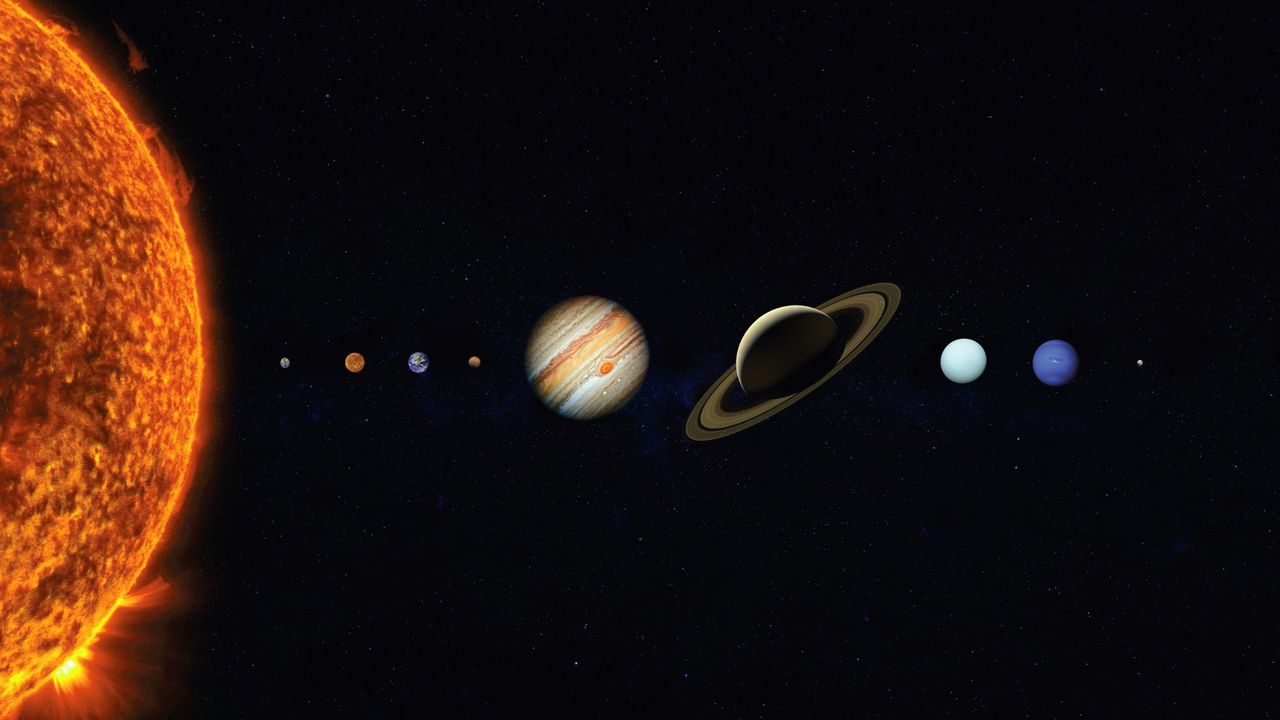
The composition of the solar system has shifted dramatically across centuries as astronomical technology and understanding advanced. When the United States declared independence in 1776, astronomers recognized only six planets: Mercury, Venus, Earth, Mars, Jupiter, and Saturn. The discovery of Uranus in 1781 by William Herschel expanded that number to seven, followed by Neptune's discovery in 1846 through mathematical predictions by Urbain Le Verrier and independent observation by Johann Galle. These additions reflected humanity's expanding ability to observe distant celestial bodies.
Pluto's discovery by Clyde Tombaugh at Lowell Observatory in 1930 briefly brought the count to nine planets. That status remained unchanged for 76 years until the International Astronomical Union fundamentally redefined what constitutes a planet. In 2006, the IAU established three criteria: a celestial body must orbit the sun, possess sufficient mass to achieve hydrostatic equilibrium (a nearly round shape), and have cleared its orbital neighborhood of other debris. Pluto failed the third criterion, losing its planetary status and becoming classified as a dwarf planet instead.
Today, eight planets orbit our sun. Scientists continue searching for additional bodies, particularly in the outer solar system. The hypothetical "Planet Nine" remains unconfirmed despite theoretical models suggesting a large, undiscovered planet may exist beyond Neptune's orbit, affecting the orbital patterns of distant icy bodies. Researchers including Konstantin Batygin and Michael E. Brown at Caltech have proposed its existence based on gravitational anomalies, though direct observation remains elusive.
The evolving solar system inventory reflects deeper changes in how science defines and categorizes celestial phenomena. Rather than ending with eight planets, the inventory may expand again if observers detect Planet Nine or other massive bodies. The solar system's story continues unfolding, shaped by both technological capabilities