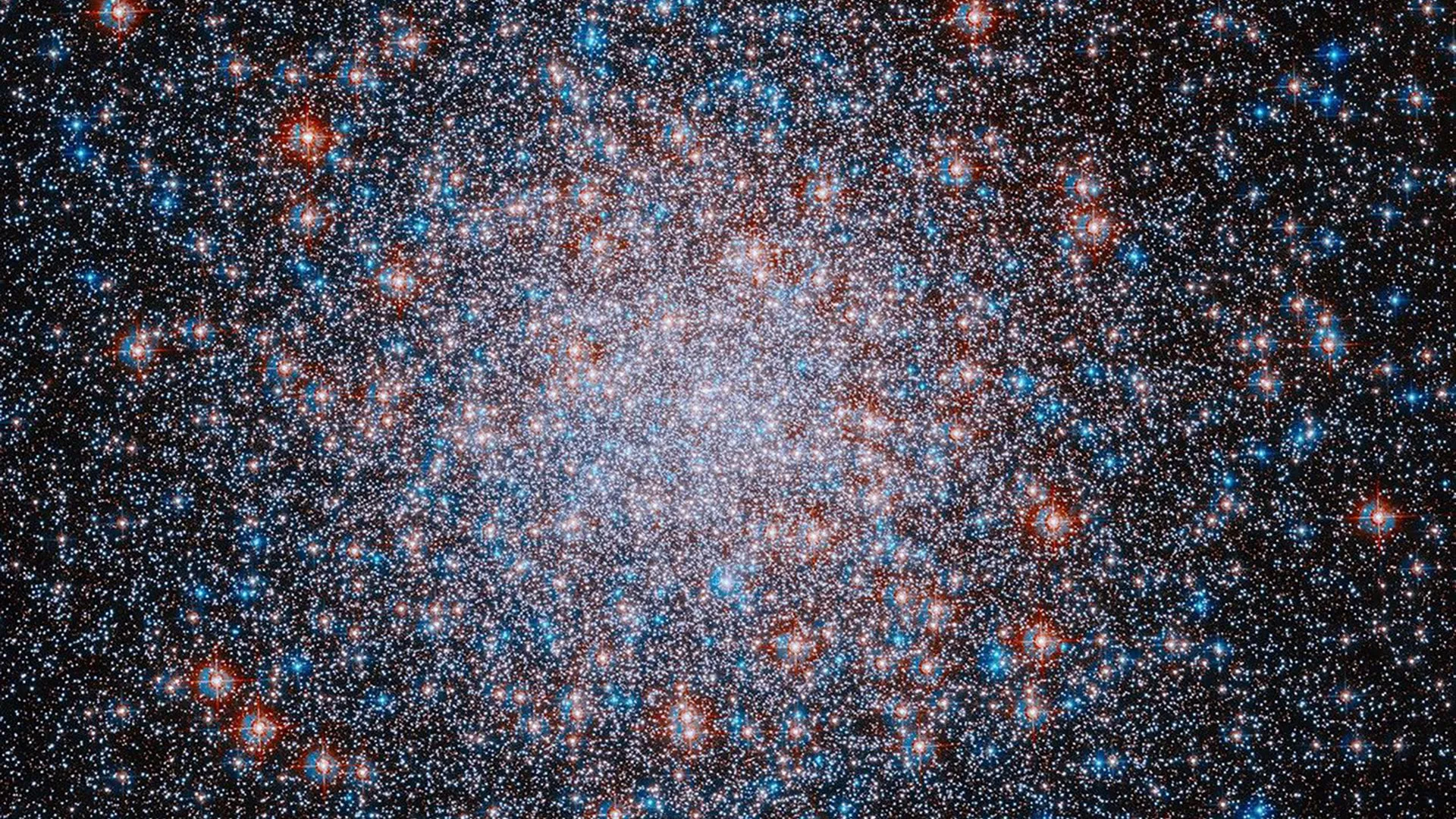
NASA's Hubble Space Telescope captured a portrait of Messier 3, a globular cluster containing over 500,000 stars, released to commemorate the United States' 250th anniversary. The cluster, located roughly 34,000 light-years from Earth, represents one of the most densely packed stellar systems observable from our vantage point.
Messier 3 holds particular scientific value for astronomers studying the Milky Way's formation history. The cluster contains rare stellar populations that provide clues about galactic evolution spanning billions of years. Researchers believe Messier 3 may originate from a cosmic merger event in the distant past, when smaller galaxies collided and merged to form the structure we observe today.
Globular clusters like Messier 3 function as cosmic laboratories. Their ancient stars retain chemical compositions unchanged since their formation, offering a record of conditions in the early universe. The extreme density of stars in these systems, combined with their age, makes them invaluable for testing models of stellar evolution and galactic dynamics.
The Hubble image reveals individual stars resolved across the cluster's face, showcasing the telescope's remarkable sensitivity even at such vast distances. The concentration increases dramatically toward the cluster's core, where gravitational forces compress stars into an extraordinarily tight configuration. This structure emerged from the interplay between gravity and the orbital mechanics of hundreds of thousands of stellar bodies interacting over cosmic timescales.
Understanding globular clusters contributes to broader knowledge about how galaxies assemble and evolve. The Milky Way hosts roughly 150 to 200 known globular clusters, each potentially carrying distinct histories. By studying clusters with different ages and chemical signatures, astronomers piece together the sequential events that shaped our galaxy's current form.
The Hubble Space Telescope, now in its fourth decade of operation, continues delivering observations that would have