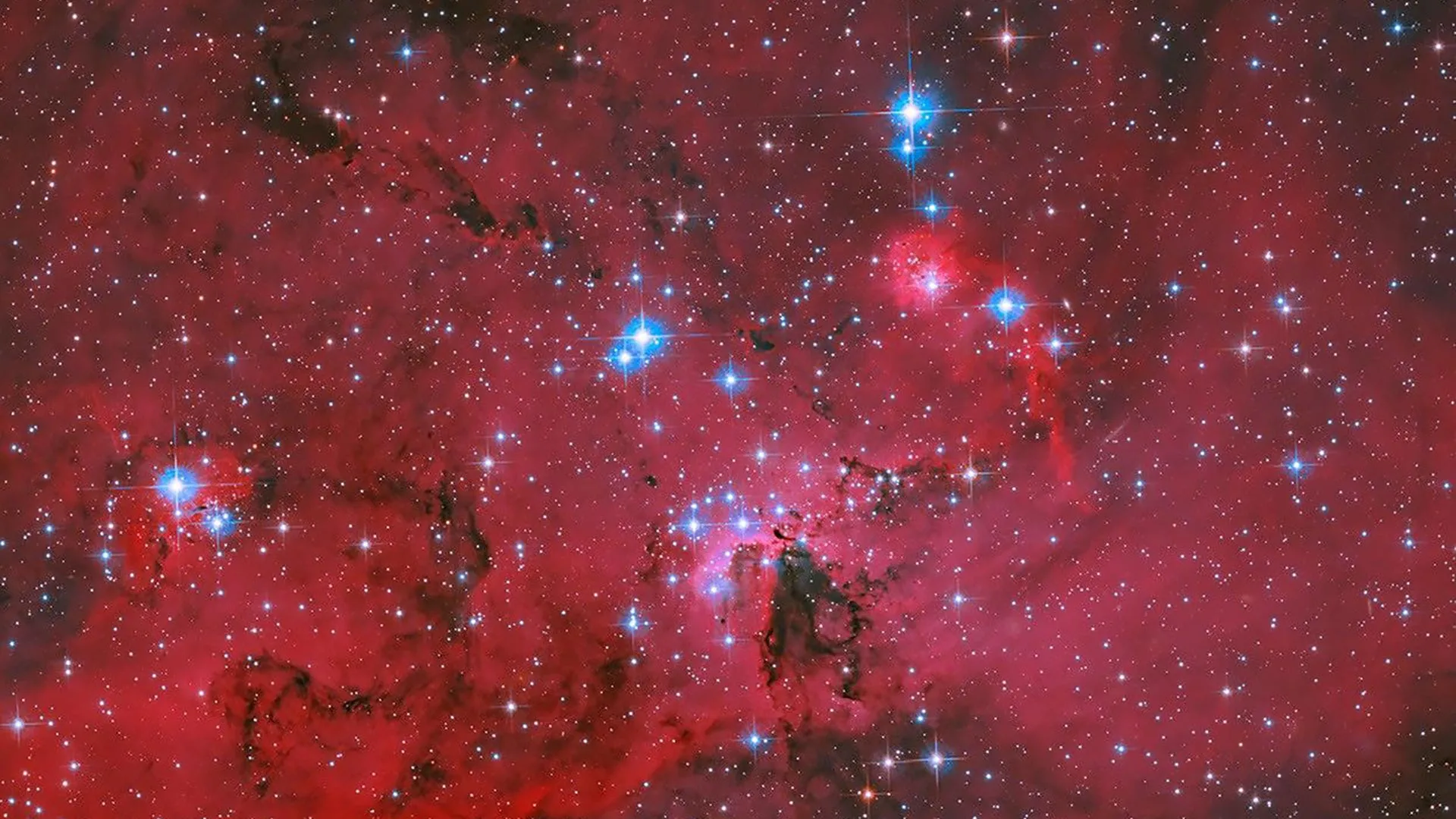
NASA's Hubble Space Telescope has imaged LH 95, a stellar nursery containing roughly 2,500 young stars still accumulating mass through ongoing gas and dust infall. The observation reveals that protostars extend their growth phase far longer than previously understood, continuing to pull material from their surroundings for millions of years.
LH 95 resides in the Large Magellanic Cloud, a satellite galaxy of the Milky Way. The region displays multiple stellar generations coexisting in the same space, with older, more developed stars existing alongside younger protostars still forming. This arrangement provides astronomers a natural laboratory for studying how star formation progresses across different timescales.
The extended growth period for young stars has implications for stellar evolution models. Astronomers had established timescales for how long protostars remain in their accretion phase, but LH 95 demonstrates this developmental window stretches longer than predicted. Stars continue capturing gas and dust from surrounding nebulae for extended periods, gradually building mass and moving toward the main sequence where they will spend most of their lives generating energy through hydrogen fusion.
The Hubble imagery captures the region's vivid coloring from ionized hydrogen gas, which glows crimson red while young hot stars emit blue and white light. This color contrast highlights the contrast between the warm gas clouds and the stellar population they birth.
Understanding stellar formation timescales matters for broader astrophysics. Star formation efficiency, the fraction of gas converted into stars versus expelled into space, depends partly on how long individual protostars accumulate material. The findings from LH 95 refine models used to interpret observations of star-forming regions throughout the universe, from nearby galaxies to the most distant galaxies observable with current telescopes.
The Hubble observations add detail to knowledge about the stellar nurseries that populated the early universe and continue