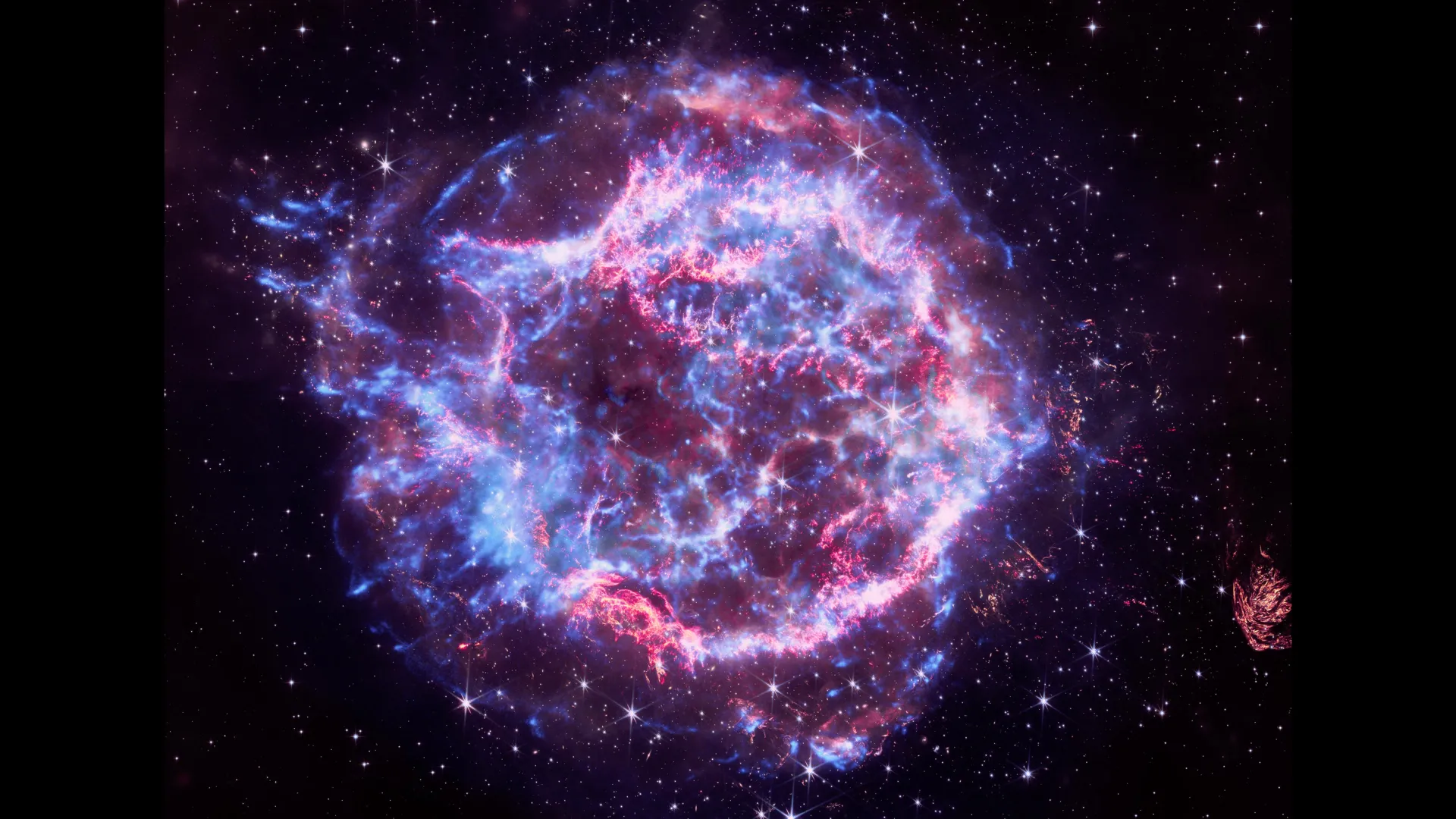
NASA released four astronomical images from the Chandra X-ray Observatory to celebrate America's 250th birthday, each featuring the patriotic colors of red, white, and blue. The collection showcases diverse cosmic phenomena captured through X-ray observation technology.
The four images include an exploded star, likely a supernova remnant that emits X-rays as material expands outward at high speeds. A stellar nursery appears in the collection, showing regions where new stars form from clouds of gas and dust. The third image depicts a galaxy undergoing rapid star formation, with intense stellar birth creating X-ray emissions. The final image captures a galaxy cluster, a collection of hundreds or thousands of galaxies bound together by gravity. This galaxy cluster serves as evidence for dark matter, the invisible substance that comprises most of the universe's mass and holds these massive structures together.
Chandra X-ray Observatory, launched by NASA in 1999, detects high-energy radiation emitted by hot gas, exploding stars, and regions near black holes. X-ray observations reveal phenomena invisible in visible light, allowing astronomers to study the universe's most energetic processes.
The color assignments in these images are artificial. Chandra's instruments detect X-rays across different energy ranges, which astronomers then assign colors for visualization. Red typically represents lower-energy X-rays, blue represents higher-energy emissions, and white shows the most intense radiation. This technique helps scientists and the public understand the intensity and composition of X-ray sources across space.
The Chandra X-ray Observatory remains one of NASA's flagship missions, operating well beyond its original design lifetime. The telescope has contributed to countless discoveries about black holes, neutron stars, and the large-scale structure of the universe. These commemorative images demonstrate how space exploration connects to national identity while advancing scientific knowledge about the cosmos.