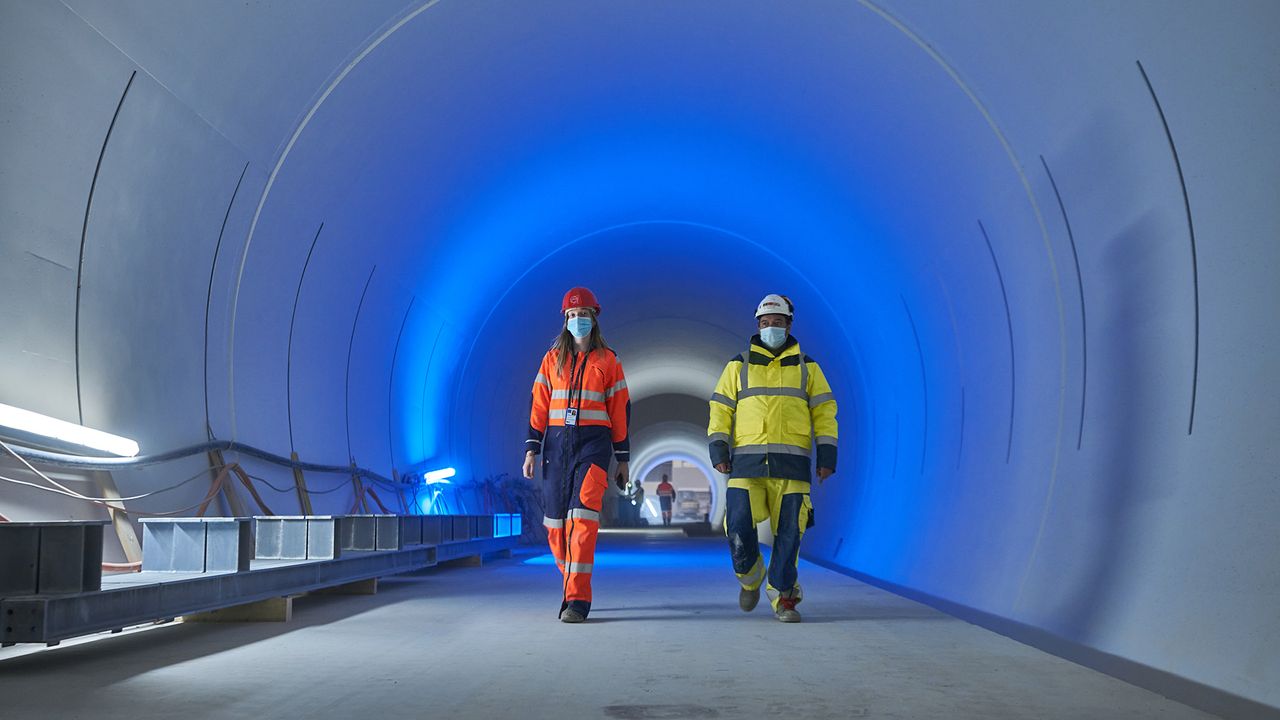
CERN has halted operations at the Large Hadron Collider for a comprehensive four-year upgrade designed to increase the instrument's sensitivity tenfold compared to its original configuration. The shutdown, which extends until 2030, represents one of the most ambitious enhancement projects in the facility's history.
The upgrade, formally called the High-Luminosity LHC project, will fundamentally enhance the collider's ability to detect particles and measure their properties. By dramatically increasing luminosity, the detector captures more collision events per unit time, enabling physicists to observe rare phenomena that occur in only a fraction of collisions. This tenfold improvement in sensitivity opens new avenues for discovering physics beyond the Standard Model.
The work involves replacing and upgrading thousands of components throughout the 17-mile circular tunnel beneath the Franco-Swiss border. Engineers will install new magnets with stronger fields, upgrade the detector systems, and enhance the accelerator's focusing capabilities. These modifications require meticulous engineering to maintain the precise alignment and performance standards necessary for cutting-edge particle physics research.
The LHC has already delivered landmark discoveries, including the confirmation of the Higgs boson in 2012. The upgraded version aims to explore deeper mysteries about the universe's fundamental nature. Scientists expect enhanced sensitivity to reveal subtle effects, measure Higgs boson properties with unprecedented precision, and potentially detect evidence of dark matter candidates or other exotic particles predicted by theoretical models.
The four-year shutdown reflects the complexity of modifying an operational research facility at this scale. CERN coordinates thousands of scientists and engineers from member states to execute the work systematically. The project demonstrates the institution's commitment to maintaining the LHC's position as the world's premier high-energy physics laboratory.
When operations resume in 2030, the enhanced collider will begin collecting data at unprecedented sensitivity levels. Physicists anticipate the upgraded facility will generate discoveries throughout