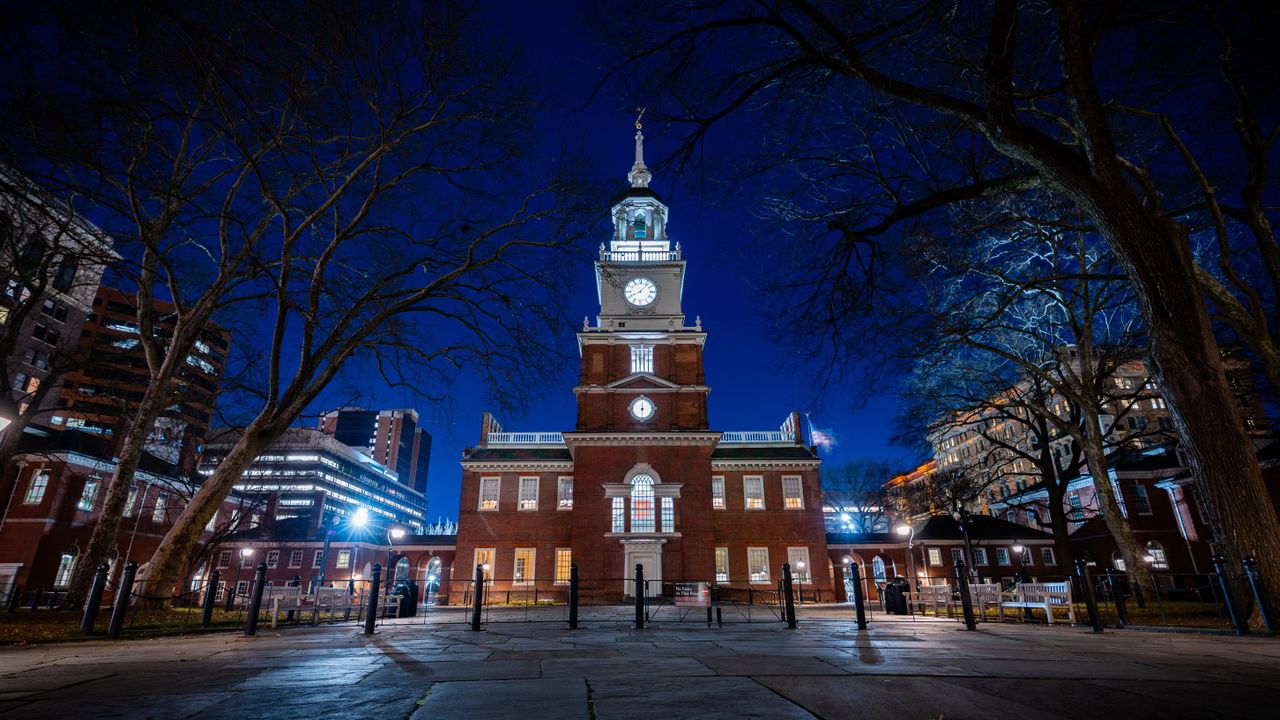
Astronomers at Planetarium software developers have recreated the night sky as it appeared on July 4, 1776, when the Declaration of Independence was signed in Philadelphia. The reconstruction offers a window into what Benjamin Franklin, Thomas Jefferson, and other founding fathers observed during that pivotal moment in American history.
On that summer evening, the Moon occupied a waning crescent phase, rising just before dawn. Jupiter dominated the western sky after sunset, shining brilliantly as the evening's brightest planet. Saturn appeared nearby, though dimmer. Venus remained invisible, having recently passed between Earth and the Sun. Mars glowed reddish in the southeast, while Mercury stayed too close to the Sun for easy viewing.
The constellation patterns remained identical to today, since star positions shift imperceptibly over centuries to human observers. However, the planets' locations differed dramatically. Rigel, Betelgeuse, and other bright stars would have marked familiar positions in the summer constellations Aquila, Lyra, and Cygnus.
The reconstruction draws on astronomical software that calculates celestial positions backward through time using precise gravitational models. These tools incorporate Earth's axial precession, orbital variations, and planetary mechanics to determine where each heavenly body hung in the sky at any historical moment.
Such reconstructions carry limitations. Ground-level observations in 1776 faced atmospheric distortion, light pollution from candles and fires, and the naked eye's detection limits. Colonists would have seen fewer stars than modern calculations suggest, while dust and haze obscured fainter objects. Additionally, no historical records survive documenting what the founding fathers specifically noted about the night sky that evening.
The exercise provides atmospheric context rather than scientific discovery. It reminds us that the cosmos the founders gazed upon operated under identical physical laws governing the heavens today. Their astronomical knowledge lagged considerably behind modern astronomy.