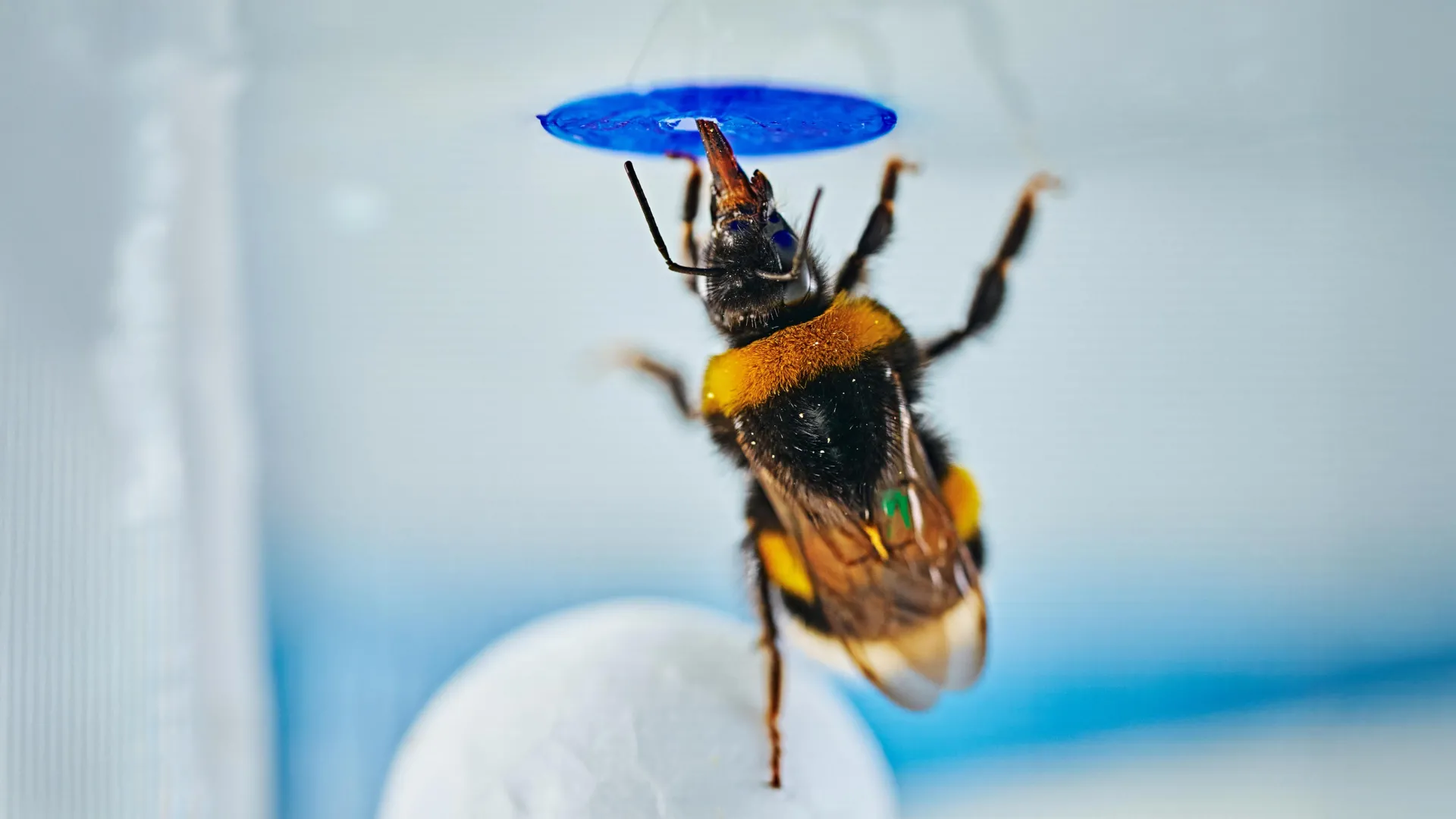
Bumble bees demonstrated unexpected problem-solving abilities by independently discovering a novel method to access a hidden reward without prior instruction. The finding emerged from research showing these insects can invent solutions to challenges they have never encountered.
Researchers presented bumble bees with a puzzle requiring them to move small balls into a specific location to trigger a reward. While some bees learned the task through observation of trained demonstrators, others spontaneously invented an alternative technique that accomplished the same goal. This behavior indicates cognitive flexibility beyond what scientists previously attributed to insects with brains smaller than a sesame seed.
The study builds on accumulating evidence that bumble bees possess sophisticated mental abilities. Previous research established they can learn through social observation, navigate complex spatial environments, and even demonstrate what researchers interpret as playful behavior. These observations challenge the traditional view of insects as purely instinctive creatures operating on fixed behavioral programs.
The bees' capacity for innovation carries practical implications. Understanding how these insects solve problems could inform artificial intelligence design and robotics. More immediately, it underscores the behavioral complexity underlying bumble bee ecology and social organization in wild colonies.
The findings also raise questions about how researchers assess animal intelligence. Standard tests often fail to capture the full range of cognitive abilities, particularly in species with radically different nervous systems from humans and other mammals. Bumble bees may possess forms of reasoning suited to their ecological needs that current testing frameworks do not adequately measure.
The research appears relevant to conservation efforts. As bumble bee populations face pressures from habitat loss and pesticide exposure, understanding their adaptability and learning capacity becomes important for predicting how colonies might respond to environmental changes. Intelligence and behavioral flexibility could influence survival rates in shifting landscapes.
The study does not specify whether all individual bees showed invention capacity or whether only certain individuals demonstrated innovation, a distinction that would clarify whether this represents a general ability or specialized cognitive talent within colonies.