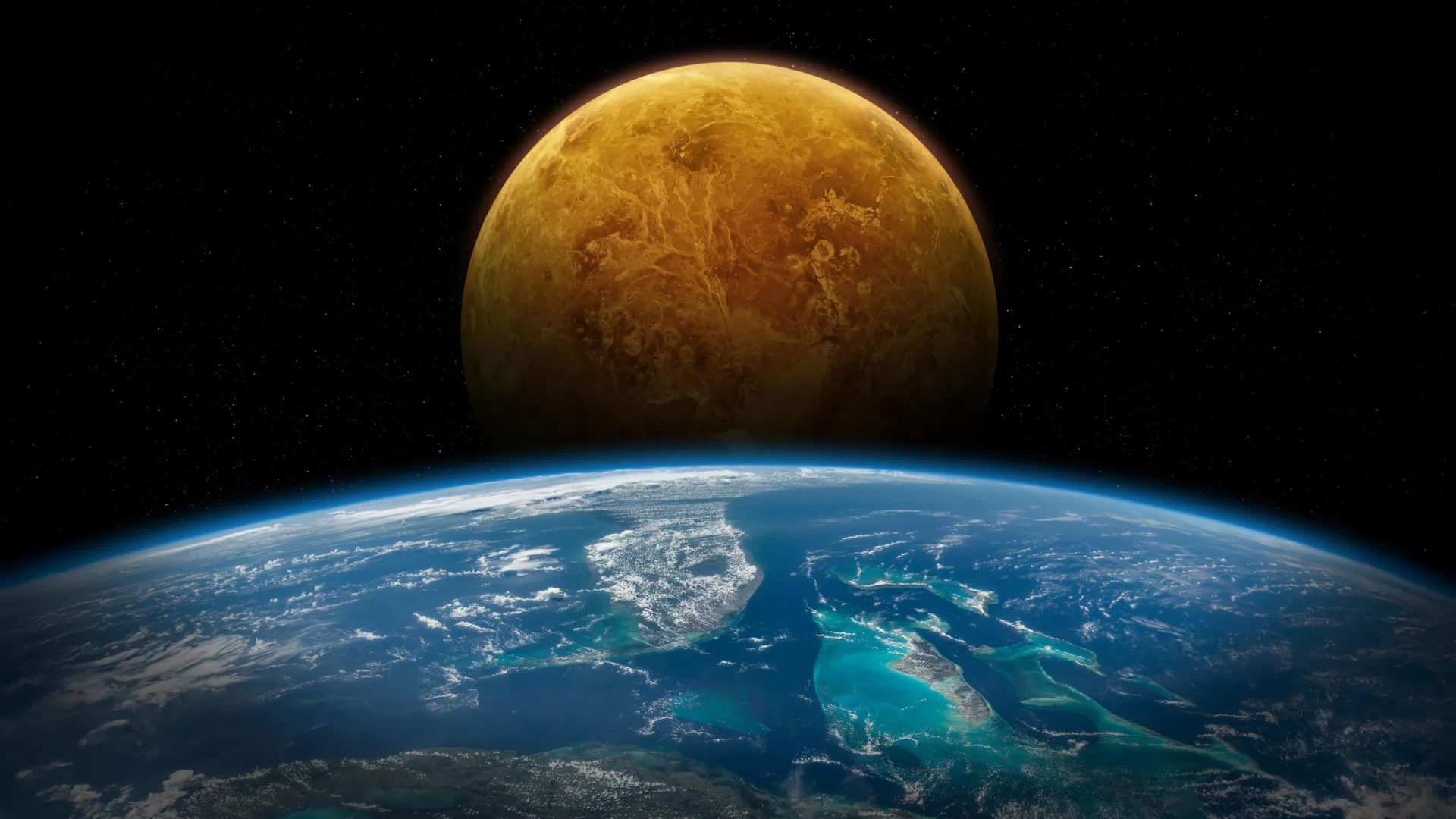
Researchers propose that Earth may have delivered microbial life to Venus across billions of years through a process driven by asteroid impacts. When asteroids strike Earth, the collisions generate enough force to launch particles and microorganisms into space. Some of these ejected microbes could potentially survive the journey through the vacuum and eventually reach Venus, where they might persist in the planet's upper atmosphere.
The study examines panspermia, the hypothesis that life spreads between planets via meteorites and comets. Rather than relying on natural interplanetary transfer mechanisms alone, the researchers focused on impact-driven ejection as a viable delivery system. Venus's clouds contain regions with temperatures and pressures surprisingly similar to Earth's atmosphere, creating pockets where microbial life could theoretically survive.
This work carries implications for future Venus exploration. Missions designed to search for biosignatures in Venus's atmosphere might discover organisms that actually originated on Earth rather than evolved independently on Venus. The finding highlights how difficult it becomes to determine a life form's true origin when two planets share close orbital proximity and a shared geological history.
The research builds on earlier studies of extremophile microorganisms that withstand radiation, extreme temperatures, and vacuum conditions. Such organisms could theoretically endure the transplanetary transit, though actual survival rates remain unknown. The study does not claim life definitely reached Venus this way, only that the mechanism is plausible given current understanding of microbial resilience and impact dynamics.
Panspermia remains controversial in astrobiology, with skeptics arguing the energy requirements and survival odds make it impractical. However, this research adds quantitative rigor to the hypothesis by modeling impact trajectories and atmospheric entry dynamics. If Venus harbors any microbial life, determining whether it represents an independent origin or an ancient Earth transplant would require genetic or isotopic analysis that current technology may struggle to achieve from orbit.