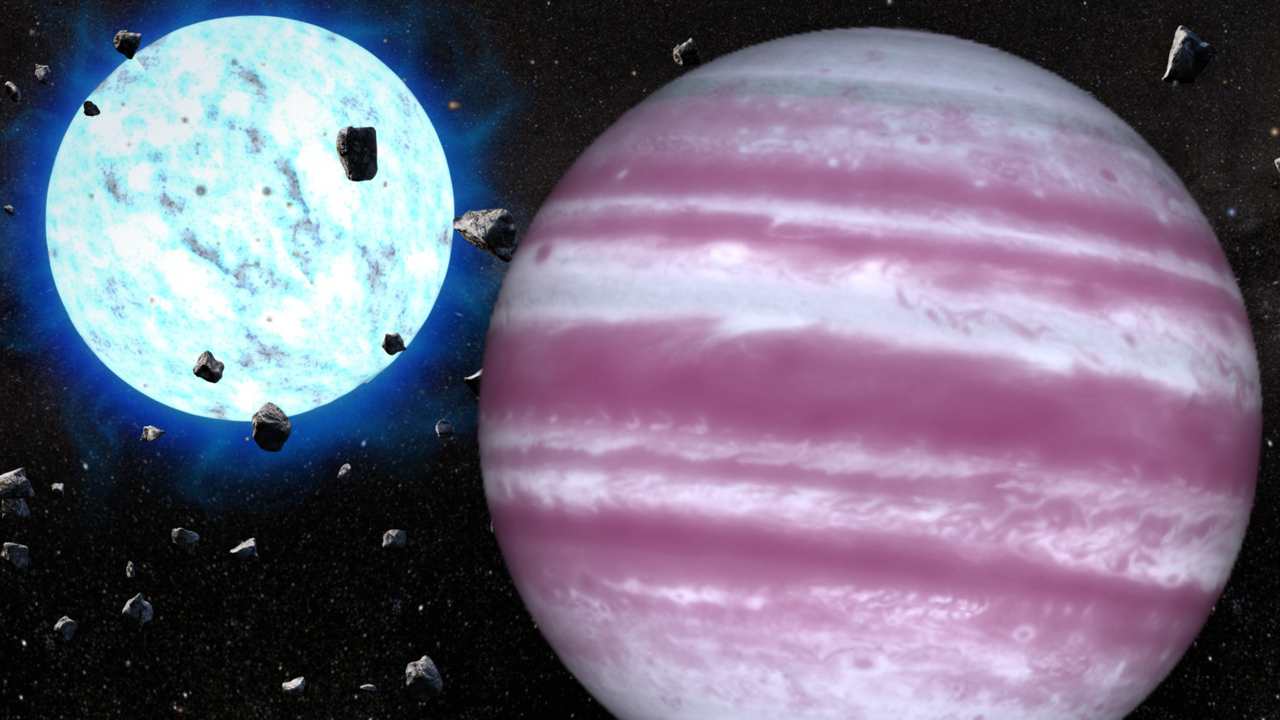
The James Webb Space Telescope has observed an exoplanet orbiting a white dwarf, offering astronomers a preview of what may happen to Earth billions of years from now. The discovery provides direct observational evidence of planetary survival around stellar remnants, researchers report.
White dwarfs are the cooling cores left behind after massive stars exhaust their fuel and shed their outer layers. The planet detected by Webb orbits this dead star at a distance comparable to Mercury's orbit around our Sun. The finding demonstrates that planets can persist through the violent death throes of their host stars, a process astronomers call the post-main-sequence phase.
"It's like using a time machine to peer into the distant future of our solar system," researchers stated, noting that our own Sun will eventually become a white dwarf in roughly 5 billion years. At that point, any surviving planets will enter a dramatically altered environment with extreme radiation and gravitational disruption.
The exoplanet shows signs of atmospheric composition distinct from what scientists expected, suggesting the white dwarf's intense radiation may have stripped or altered the planet's atmosphere over time. This atmospheric processing offers clues about how planetary chemistry transforms around dead stars.
Detecting planets around white dwarfs remains technically challenging because these stellar remnants emit far less light than living stars, making planets harder to spot. Webb's infrared capabilities allow it to identify thermal signatures and reflected light from these distant worlds with unprecedented sensitivity.
The discovery has implications for understanding planetary habitability and survival in extreme stellar environments. While Earth's prospects appear grim in the distant future, the detection of a surviving exoplanet suggests that some worlds may endure the chaos of stellar death. The findings also help astronomers refine models of planetary migration and evolution during the late stages of stellar systems.
This observation represents another milestone in Webb's mission to reveal planetary systems across the universe and their extreme diversity. Further observations of