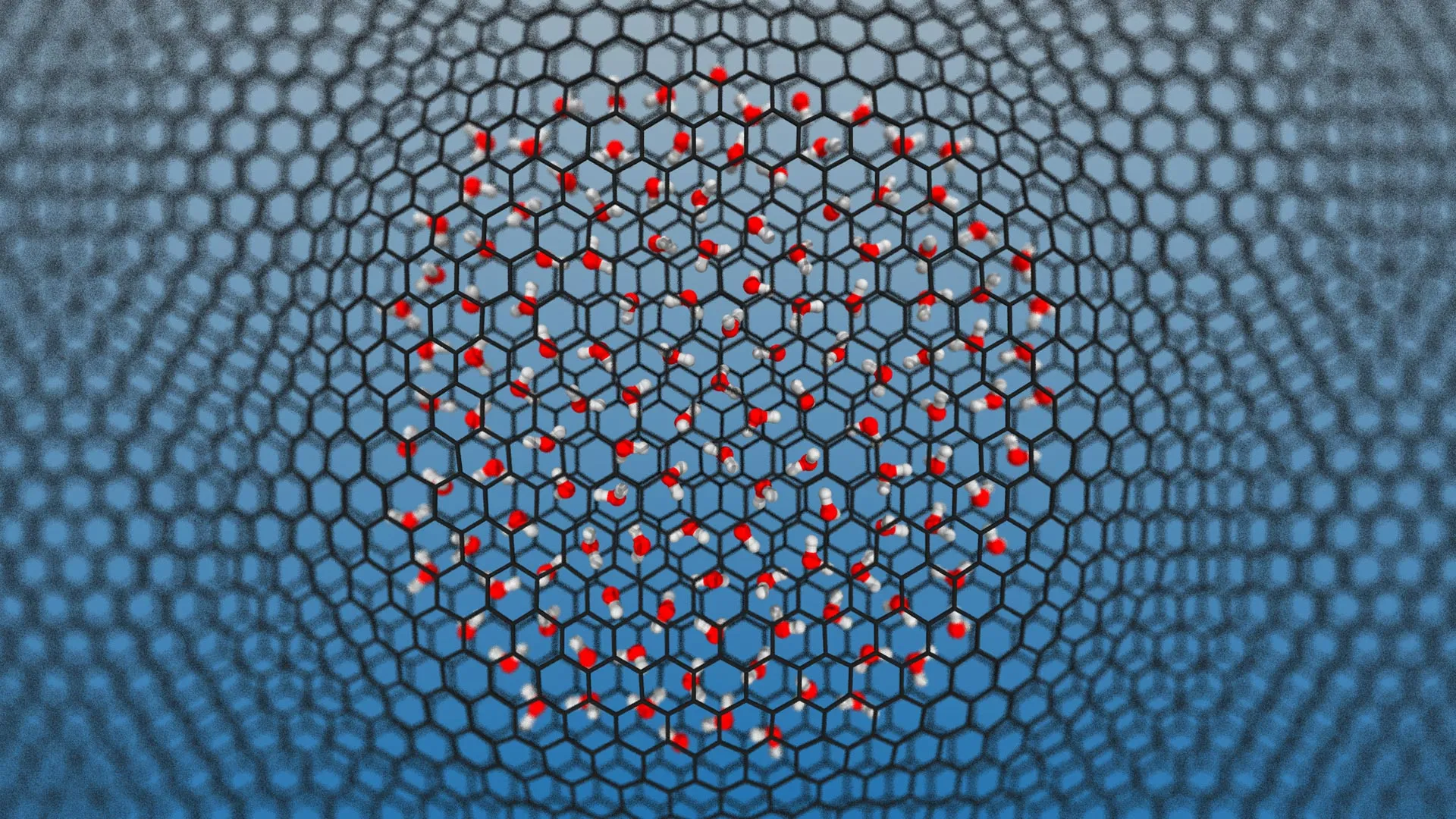
A longstanding mystery about confined water's behavior has been resolved by new research clarifying how water behaves when squeezed into nanoscale spaces.
Scientists discovered that water trapped in tiny gaps doesn't become inherently more chemically reactive simply by being confined. Instead, the dramatic pressure buildup inside these microscopic cavities drives most of the increased reactivity. The surrounding material plays a secondary but important role, enhancing water's chemistry only when it directly interacts with reaction products.
This finding addresses a debate that has puzzled researchers for decades. Previous studies suggested confined water had unusual properties, but the exact mechanism remained unclear. The new work identifies mechanical pressure as the primary driver, with the container's chemical properties acting as a secondary influence.
Understanding confined water matters for practical applications. Nanoscale water affects drug delivery systems, water purification technologies, and materials science. In biological systems, water confined in cell membranes and protein channels influences how cells function. Industrial processes also rely on controlling water in tiny spaces to speed up chemical reactions or improve efficiency.
The research reveals that the pressure effect dominates the confined space chemistry. When water molecules pack tightly into nanometer-scale gaps, the physical compression alone substantially increases their reactivity. The surrounding material then modulates this effect. If the container walls interact chemically with the products being formed, they can amplify the reaction further. If not, the pressure effect operates largely independently.
This mechanistic understanding allows scientists to predict and control water chemistry in confined spaces more precisely. Engineers can now design better nanofluidic devices by accounting for pressure effects alongside material selection. The finding also suggests that confining water in different sized spaces produces predictable changes in reactivity based on the pressure generated.
The discovery demonstrates how breaking down complex phenomena into their components yields clearer insights. Rather than attributing confined water's behavior to mysterious "nanoscale effects," researchers now understand the specific physical