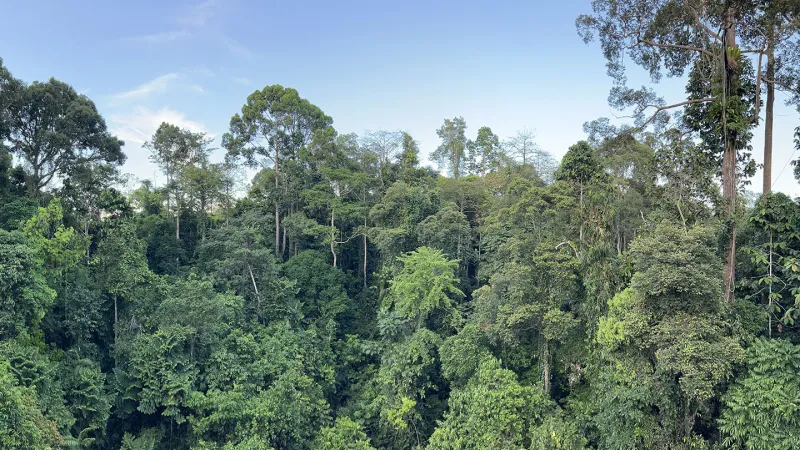
Researchers have gathered direct evidence that giant trees employ sophisticated mechanisms to survive drought, settling a decades-old scientific debate about how the tallest organisms on Earth adapt to water stress.
Scientists collected samples from the canopies of coast redwoods and other large trees at extreme heights, a physically demanding feat that yielded the first empirical support for the "hydraulic redistribution" hypothesis. This process allows trees to move water from deeper, wetter soil layers upward through their roots and release it into drier upper soil regions at night, effectively redistributing moisture throughout the root zone.
The research challenges the competing "hydraulic failure" theory, which predicted that tall trees simply shut down water transport during droughts to prevent their vascular systems from collapsing. Instead, the findings demonstrate that giant trees actively manage water distribution rather than passively surrendering to drought conditions.
Tree physiologists have long struggled to explain how redwoods and other tall species maintain water transport across their immense heights. Water must travel hundreds of feet against gravity to reach upper canopies, creating physical pressures that can rupture the tree's internal plumbing during dry periods. The hydraulic failure model suggested trees simply accepted this limitation by cutting off water flow.
The new data, collected from canopy heights previously inaccessible to researchers, shows trees instead engage in nighttime hydraulic redistribution. This active process pumps water upward when atmospheric demand is low, allowing trees to rehydrate upper tissues and prepare for daytime photosynthesis.
The samples analyzed included root tissue and xylem fluid from multiple species across various drought conditions. This direct evidence from the trees themselves proves more definitive than previous laboratory experiments or modeling studies alone.
These findings reshape understanding of drought resilience in forest ecosystems and may inform conservation strategies as climate change intensifies water stress. The research suggests that giant trees possess more adaptive capacity than previously recognized, though extreme