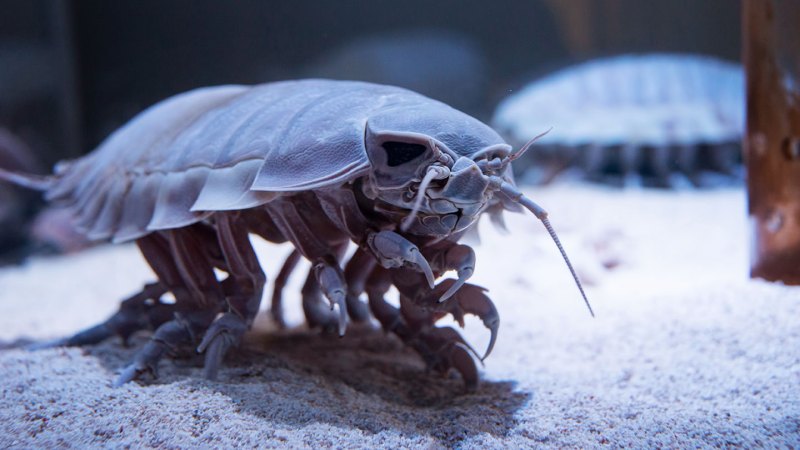
Giant deep-sea isopods survive extreme food scarcity through a bacterial gene they acquired, allowing them to endure starvation for up to five years. Researchers identified this horizontal gene transfer, where the creature's genome incorporated genetic material directly from bacteria rather than inheriting it through normal reproduction.
These isopods, which can reach 16 inches in length, inhabit the ocean floor where food arrives unpredictably. The stolen gene encodes an enzyme that helps break down fatty acids for energy when other nutrients disappear. This metabolic adaptation lets them enter a state of extremely low activity and survive on minimal resources for years.
Scientists examining isopod genomes discovered the bacterial gene integrated into their chromosomes. The gene functions similarly to versions found in bacteria that degrade complex molecules. Unlike their garden-variety cousins, which weigh fractions of an ounce, giant deep-sea isopods evolved this capability to match their extreme environment.
Horizontal gene transfer occurs more frequently in bacteria but remains rare in animals. The discovery in isopods demonstrates that larger organisms can successfully adopt microbial genes when selective pressure demands it. The deep sea presents continuous evolutionary pressure. Food falls sporadically to the ocean floor as organic matter drifts down from upper layers. Animals that cannot store energy efficiently or access alternative nutrient sources simply starve.
This research reveals how organisms adapt to Earth's harshest environments. The five-year starvation tolerance represents an extreme survival strategy. Other deep-sea creatures show similar adaptations, though this bacterial gene acquisition represents a particularly dramatic example of evolutionary innovation.
The finding also has broader implications for understanding evolution. Scientists previously assumed that complex organisms rarely benefit from bacterial genes due to their different cellular machinery. The isopod case proves exceptions exist and provides a model for studying how such transfers benefit survival in extreme conditions.