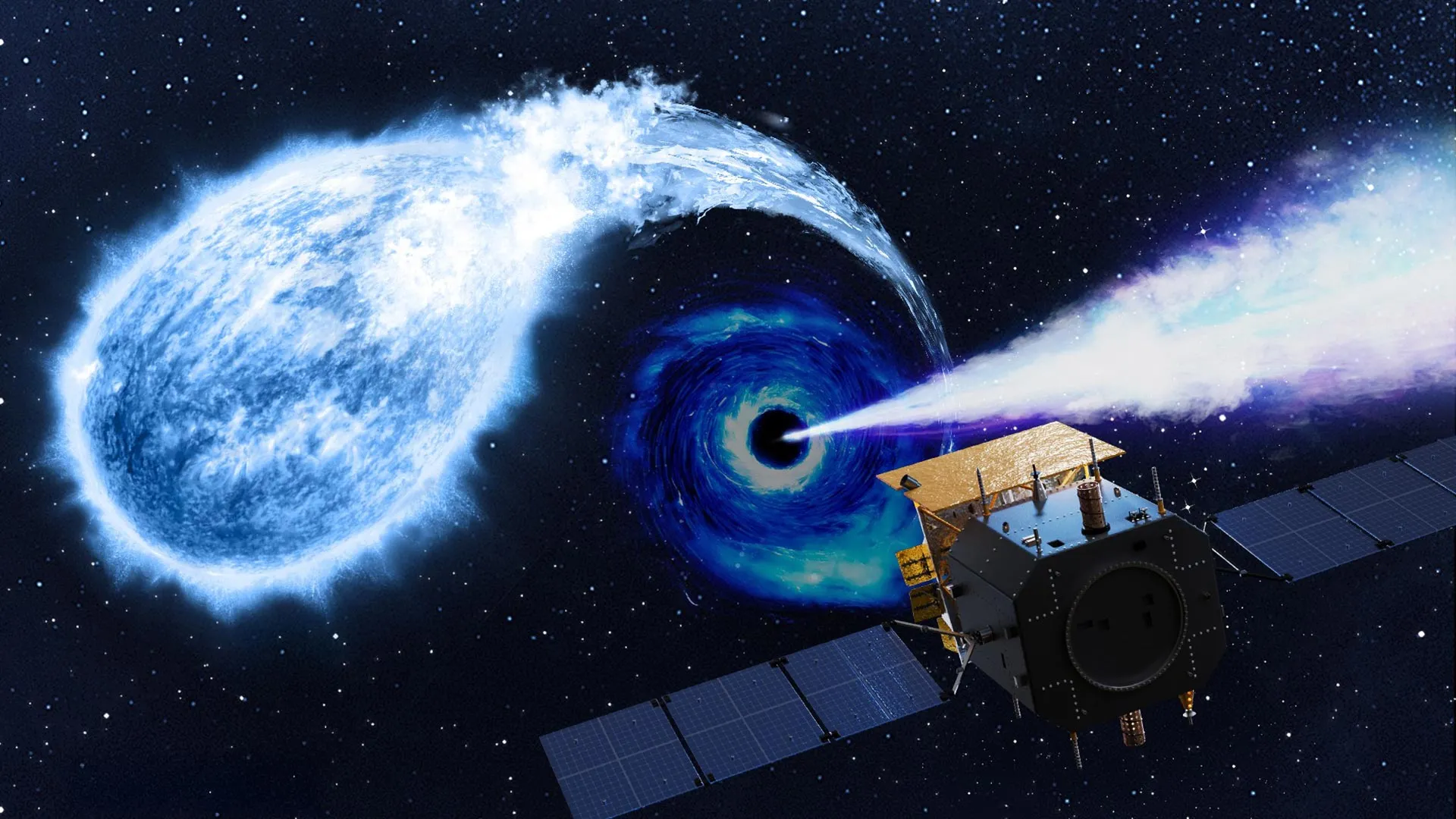
The Einstein Probe space telescope has potentially detected an intermediate-mass black hole destroying a white dwarf star, capturing the violent event in unprecedented detail during its initial explosion. Astronomers observed a sequence of intense X-ray flashes that deviate markedly from patterns seen in typical gamma-ray bursts, suggesting this represents a rare tidal disruption event.
White dwarfs are extremely dense stellar remnants, typically the size of Earth but containing a star's mass. When such an object ventures too close to a black hole, the black hole's gravitational pull tears the white dwarf apart in a process called spaghettification. The Einstein Probe's early detection of this event provides astronomers with a rare opportunity to study how material behaves as it falls into a black hole at the beginning of this catastrophic process.
The unusual X-ray signature distinguishes this event from standard gamma-ray bursts, which originate from collapsing massive stars or merging neutron stars. The intermediate-mass black hole itself represents a particularly elusive target for astronomers. While stellar-mass black holes and supermassive black holes are well-documented, intermediate-mass black holes remain poorly understood, with only a handful of confirmed detections.
The Einstein Probe observatory, a collaboration involving Chinese and European institutions, specializes in detecting rapid X-ray transients and following them with precise timing. Its ability to catch this event early provides crucial data on how material heats and accelerates as it approaches a black hole's event horizon.
Researchers worldwide are now analyzing the telescope's observations to confirm the black hole's mass and understand the physics governing this extreme interaction. Additional observations from other telescopes may help characterize the system further.
This detection advances understanding of rare black hole-star interactions and demonstrates the value of dedicated transient-detection missions in capturing fleeting cosmic phenomena before they fade.