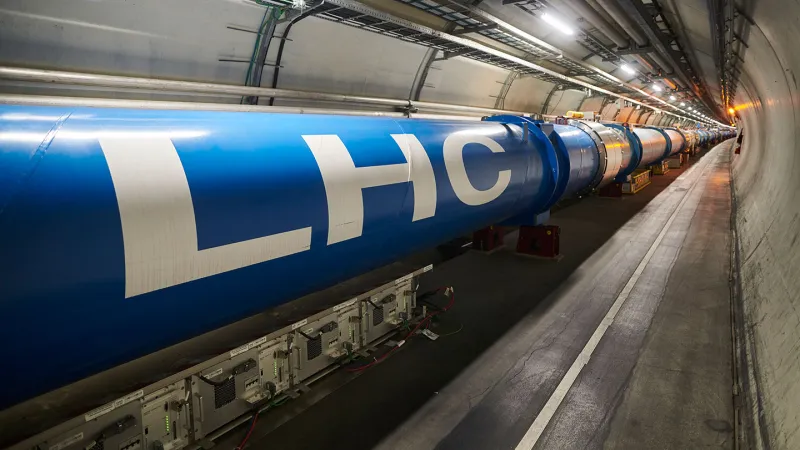
CERN halted operations at the Large Hadron Collider to begin a comprehensive upgrade project aimed at dramatically increasing its discovery potential. The facility will shut down to make way for the High-Luminosity LHC, which physicists expect to activate in 2030.
The upgrade will fundamentally enhance the collider's performance. By increasing luminosity, the machine will generate far more particle collisions per unit time, allowing researchers to gather vastly larger datasets. This capacity boost opens pathways to detecting rare particle interactions that current equipment cannot observe.
The High-Luminosity LHC targets several unsolved physics questions. Scientists hope the upgraded facility will reveal deeper properties of the Higgs boson, the particle discovered in 2012 that explains how fundamental particles acquire mass. The experiment also aims to investigate dark matter, the invisible substance that comprises roughly 85 percent of the universe's matter but remains largely mysterious.
The transformation involves installing new detector systems, upgrading magnet technology, and enhancing the accelerator's infrastructure. Engineers will replace aging components and implement cutting-edge equipment to handle the increased collision rates. These modifications represent one of CERN's most ambitious infrastructure projects since the original collider began operations in 2008.
The 2030 startup date reflects the complexity of the undertaking. CERN estimates the project will take several years of intensive construction and testing. The investment demonstrates the international physics community's commitment to addressing fundamental questions about particle physics that standard model theories cannot yet explain.
This upgrade carries implications beyond particle physics. Advances in detector technology and magnet systems often yield spinoff applications in medical imaging, industrial processes, and other fields. The High-Luminosity LHC represents a collaborative effort involving thousands of scientists and engineers from institutions worldwide, pooling expertise and resources to push the boundaries of human knowledge about the universe's basic structure.