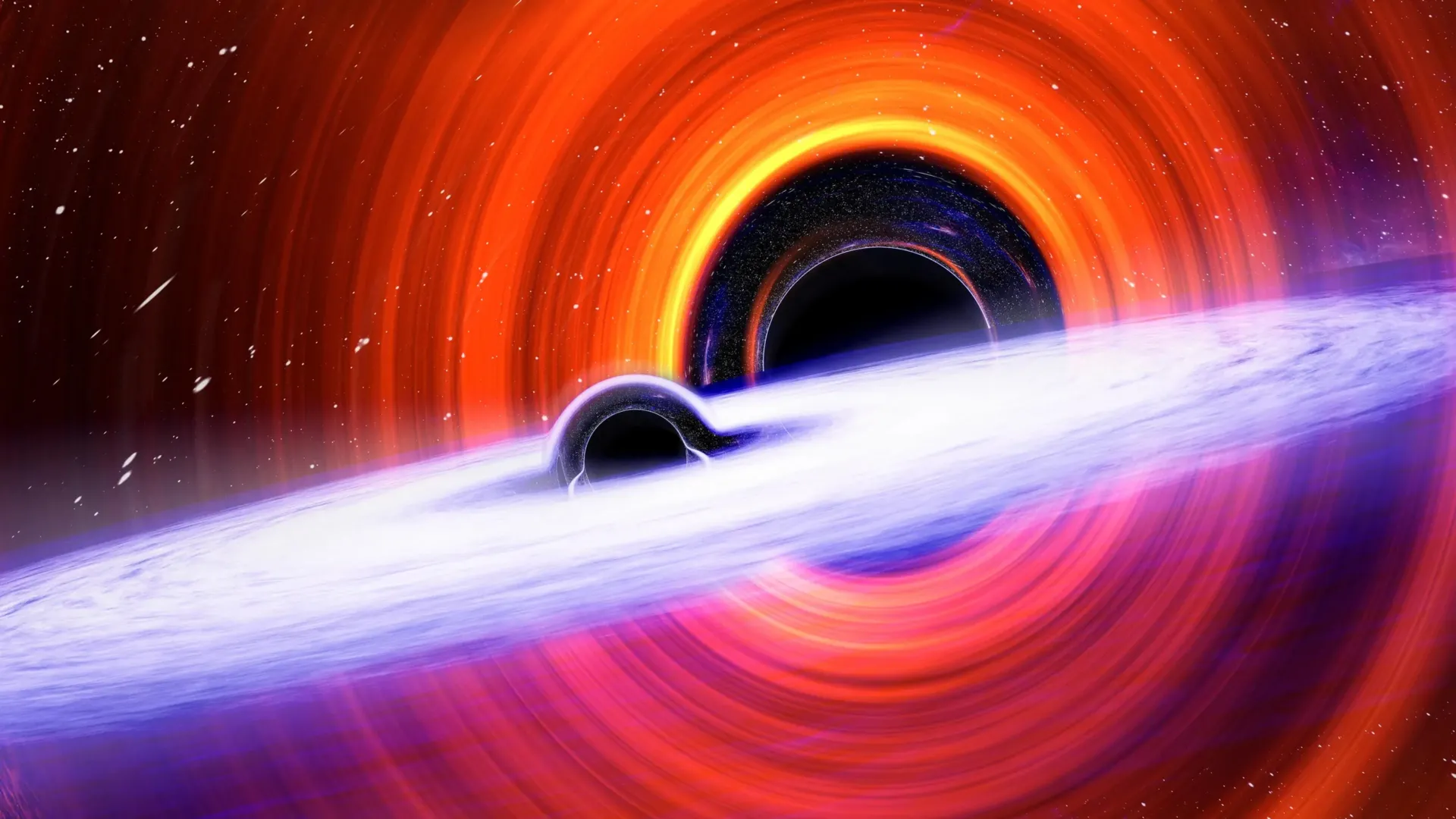
Researchers analyzing data from the Laser Interferometer Gravitational-Wave Observatory (LIGO) have detected an anomalous gravitational wave signal that could point toward primordial black holes, objects formed in the universe's earliest moments that have long remained hypothetical.
Primordial black holes differ from stellar black holes, which form when massive stars collapse. Instead, these objects would have emerged from density fluctuations in the first fraction of a second after the Big Bang. Their detection has eluded astronomers for decades, yet they represent a leading candidate for dark matter, the invisible substance that comprises roughly 85 percent of the universe's matter.
The unusual LIGO signal exhibits characteristics inconsistent with typical gravitational wave sources from merging stellar-mass black holes or neutron stars. The anomaly has sparked renewed interest in whether primordial black holes populate the universe in sufficient numbers to account for dark matter's observed gravitational effects.
Dark matter remains one of astrophysics' most persistent puzzles. While its gravitational influence on galaxies, galaxy clusters, and cosmic structure proves undeniable, its actual composition eludes identification. Standard particle physics offers no clear explanation, making alternative theories like primordial black holes increasingly attractive to researchers.
If primordial black holes constitute dark matter, they would solve multiple astronomical problems simultaneously. They could explain the prevalence of surprisingly massive black holes observed in the early universe, phenomena that current stellar evolution models struggle to account for. Additionally, they might illuminate the gravitational wave sources that LIGO and other detectors continue recording.
However, substantial uncertainties persist. The reported signal requires further analysis to confirm its origin. Other astrophysical phenomena could produce similar gravitational wave patterns. Confirmation demands additional detections showing consistent characteristics across multiple observation runs and independent detector networks like Virgo and KAGRA.
The research underscores LIGO