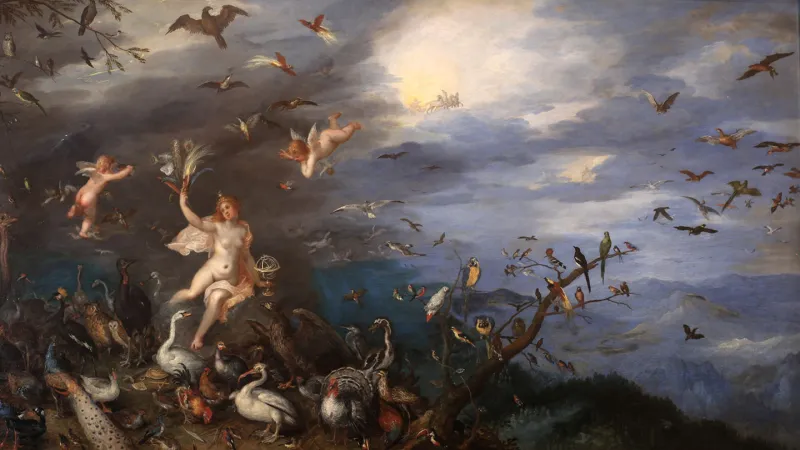
A Renaissance painting by Jan Brueghel the Elder has revealed a behavior that scientists only recently confirmed. The 17th-century artwork depicts a bat consuming a bird, a feeding pattern that researchers did not formally document until the 21st century.
The painting, created roughly 400 years ago, shows what naturalists and art historians now recognize as an accurate representation of carnivorous bat behavior. This discovery emerged from careful analysis of the work's details, which align with modern understanding of certain bat species that hunt vertebrates rather than relying solely on insects or plant matter.
Brueghel the Elder, who lived from 1568 to 1625, was known for his meticulous natural history paintings. His work reflected both artistic skill and close observation of the natural world. The presence of this predatory behavior in his art suggests Renaissance naturalists possessed detailed knowledge about animal behavior that went unrecognized or unverified by the broader scientific community for centuries.
Scientists studying the painting recognized the anatomical accuracy and behavioral detail Brueghel included. The image documents a feeding strategy employed by certain bat species, particularly some Old World bats capable of hunting small vertebrates. This behavior was not systematically studied or published in scientific literature until recent decades, when researchers observed bats like Davy's fringe-lipped bat engaging in such predation.
The finding underscores how historical artwork can serve as an unexpected archive of zoological knowledge. Artists working centuries ago sometimes captured behaviors and anatomical details that science would only later verify through systematic observation and documentation. This particular painting exemplifies how keen observation existed in earlier periods, even when formal scientific confirmation came much later.
The overlap between art and natural history demonstrates that accurate representations of animal behavior transcended the boundaries between artistic and scientific disciplines during the Renaissance. Brueghel's work provides a remarkable window into both the visual culture and the observational