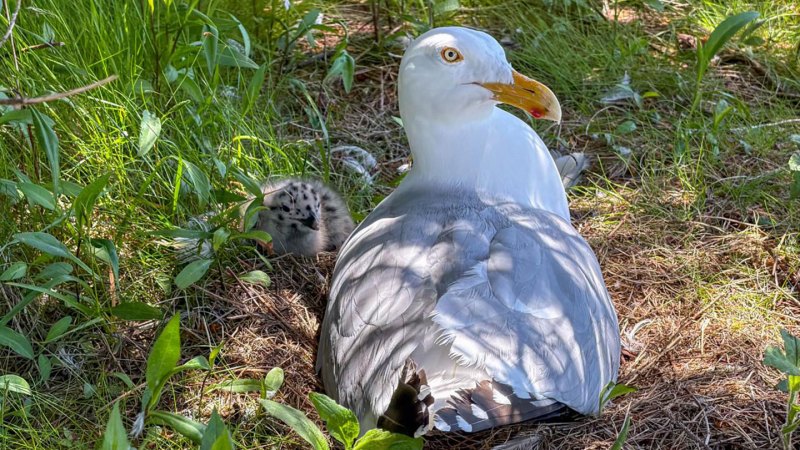
Researchers testing juvenile gull camouflage have discovered that young birds' drab plumage serves as a crucial deterrent against aggression from territorial adults. Scientists painted decoys to mimic both adult and juvenile gulls, then placed them near active nesting sites to observe how resident birds responded.
Adult gulls attacked adult-colored decoys significantly more often than juvenile-colored ones. The finding suggests that immature plumage functions as a social signal, essentially telling nesting adults: "I'm not a threat to your territory." This discovery adds a new dimension to understanding how juvenile birds survive in competitive environments where adults fiercely defend nesting and feeding areas.
The research reveals an elegant evolutionary solution. Young gulls cannot compete physically with established adults, so their duller coloring reduces the likelihood of lethal confrontations. Instead of triggering territorial defense, juvenile plumage suppresses aggression through visual recognition. This behavioral flexibility in adults appears shaped by selection pressure favoring tolerance of non-threatening young birds, particularly when they do not pose reproductive competition.
The study's use of painted decoys provided a controlled experimental design that isolated the effect of plumage color from confounding variables like size, behavior, or scent. By manipulating only the visual signal, researchers demonstrated that coloring alone influences adult gull behavior.
The implications extend beyond gulls. Many species display age-specific plumage patterns, and similar mechanisms may explain why juveniles of numerous bird species wear distinctly different feathers than adults. Understanding these visual signals could inform conservation efforts for species where human activity has disrupted natural age structure in populations.
The work also highlights how predator-prey relationships shape not just hunting behavior but social hierarchies and recognition systems within species. Avoiding unnecessary conflict through visual signaling represents an energy-efficient survival strategy that benefits both juveniles and territorial adults.