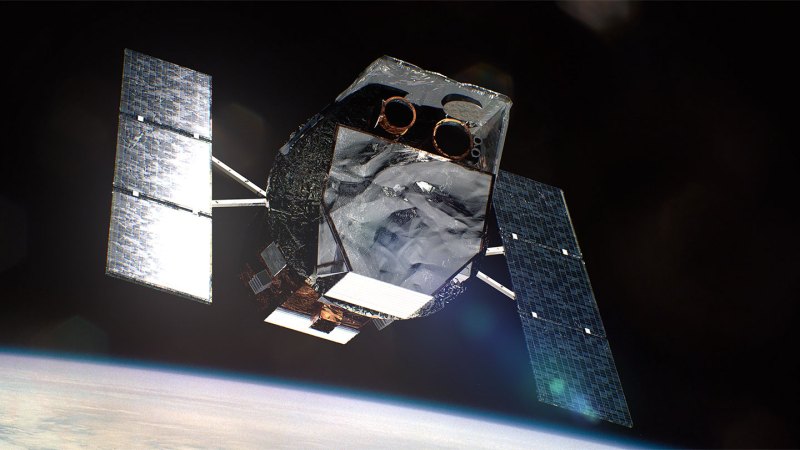
NASA's Swift gamma-ray burst observatory faces deorbiting within years as atmospheric drag slowly pulls it toward Earth. A private spacecraft may intervene before the 21-year-old satellite becomes space debris.
Swift has spent two decades detecting sudden flares of gamma radiation from distant stellar explosions and neutron star collisions. These bursts last mere seconds but release more energy than our Sun will in its entire lifetime. The telescope's instruments remain scientifically productive, making loss of the spacecraft premature.
The mission orbits at roughly 600 kilometers altitude, where trace atmospheric molecules create drag. This friction gradually lowers the orbit. Without intervention, Swift will reenter Earth's atmosphere within approximately five years, where friction will destroy it.
A commercial spacecraft could perform an orbital reboost, pushing Swift to a higher, more stable trajectory. This approach mirrors historical practice. Astronauts serviced the Hubble Space Telescope multiple times. The International Space Station receives regular reboosts from visiting cargo vehicles to counteract atmospheric decay.
Swift's declining orbit presents both opportunity and risk. A controlled boost extends its scientific operations, while uncontrolled reentry risks creating debris that could strike other satellites or reach Earth's surface. The spacecraft's propellant reserves remain depleted from decades of station-keeping maneuvers, eliminating self-rescue options.
The private space industry has demonstrated increasing capability for orbital operations. Companies now offer servicing, refueling, and debris removal services. A robotic mission to Swift would test commercial capacity for scientific asset preservation.
Swift's gamma-ray detectors remain unmatched at detecting transient events across the universe. Ground-based observatories cannot match its rapid response time. Extended operations would maintain this unique capability while other gamma-ray missions age or face budget constraints.
Negotiations between NASA and private contractors continue. Success requires careful approach procedures and mechanical compatibility between decades-