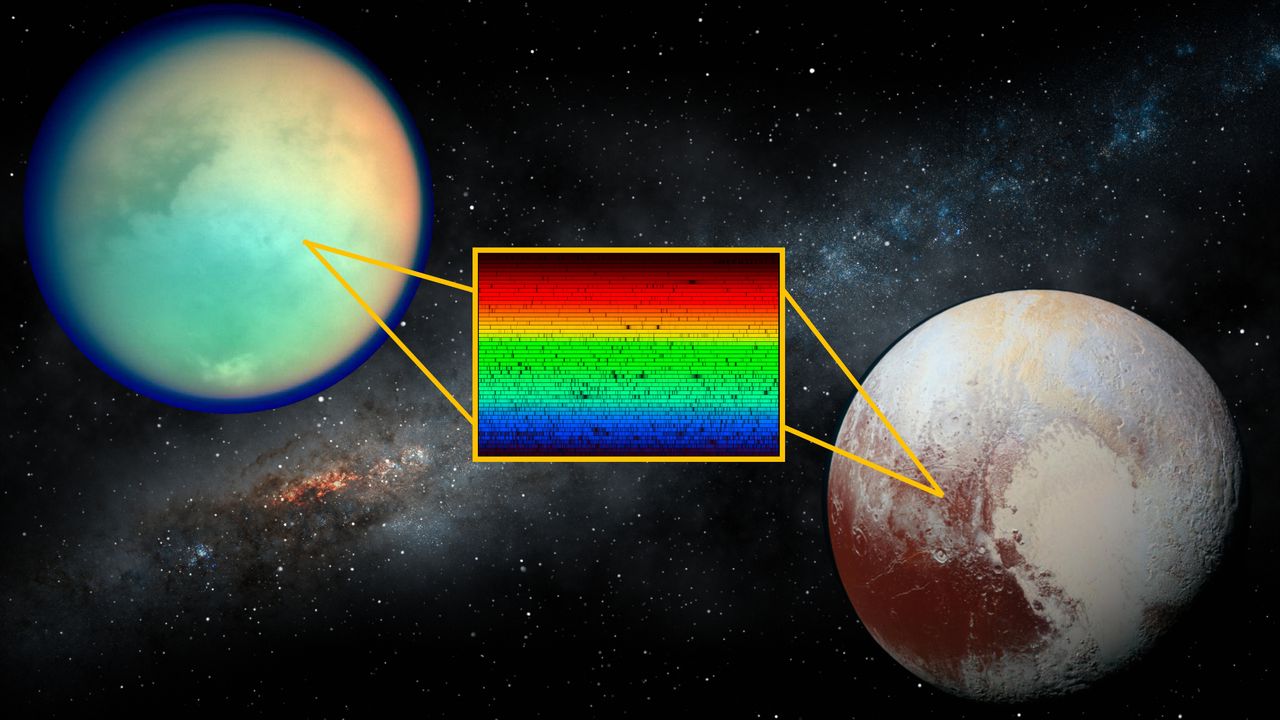
The James Webb Space Telescope has detected an unusual absorption signature in light from both Pluto and Titan, Saturn's largest moon, pointing to a previously unknown molecule on both worlds. Researchers identified a specific wavelength of light that vanishes when passing through the atmospheres or surfaces of these distant bodies, a pattern that doesn't match any known chemical compound.
The finding emerges from spectroscopic analysis, a technique that breaks light into component wavelengths to reveal chemical composition. When light from distant sources passes through a substance, certain wavelengths are absorbed by molecules present there, creating a distinctive fingerprint. The team detected an absorption feature at a wavelength not previously catalogued in any solar system object or interstellar environment.
This discovery carries substantial implications for planetary science. Pluto and Titan represent distinct worlds. Pluto, a dwarf planet in the outer solar system, has a thin nitrogen atmosphere and frozen surface composed of methane and water ice. Titan possesses a thick nitrogen atmosphere with methane lakes and organic chemistry driven by ultraviolet light from the distant Sun. That the same unknown molecule appears on both suggests either a previously underappreciated chemical process or compounds formed under extreme conditions at the solar system's outer reaches.
The mystery deepens because the wavelength signature doesn't align with theoretical predictions of which molecules should exist in these environments. Researchers must now conduct additional observations and laboratory experiments to narrow down the chemical identity of this substance. Future Webb observations targeting these worlds could provide higher-resolution data. Laboratory work recreating the temperature and pressure conditions found on Pluto and Titan may help chemists synthesize and identify candidate molecules.
The discovery underscores how much remains unknown about planetary compositions even with advanced observational technology. It also demonstrates Webb's capability to detect subtle chemical signatures across vast distances, opening new avenues for understanding chemistry beyond Earth.