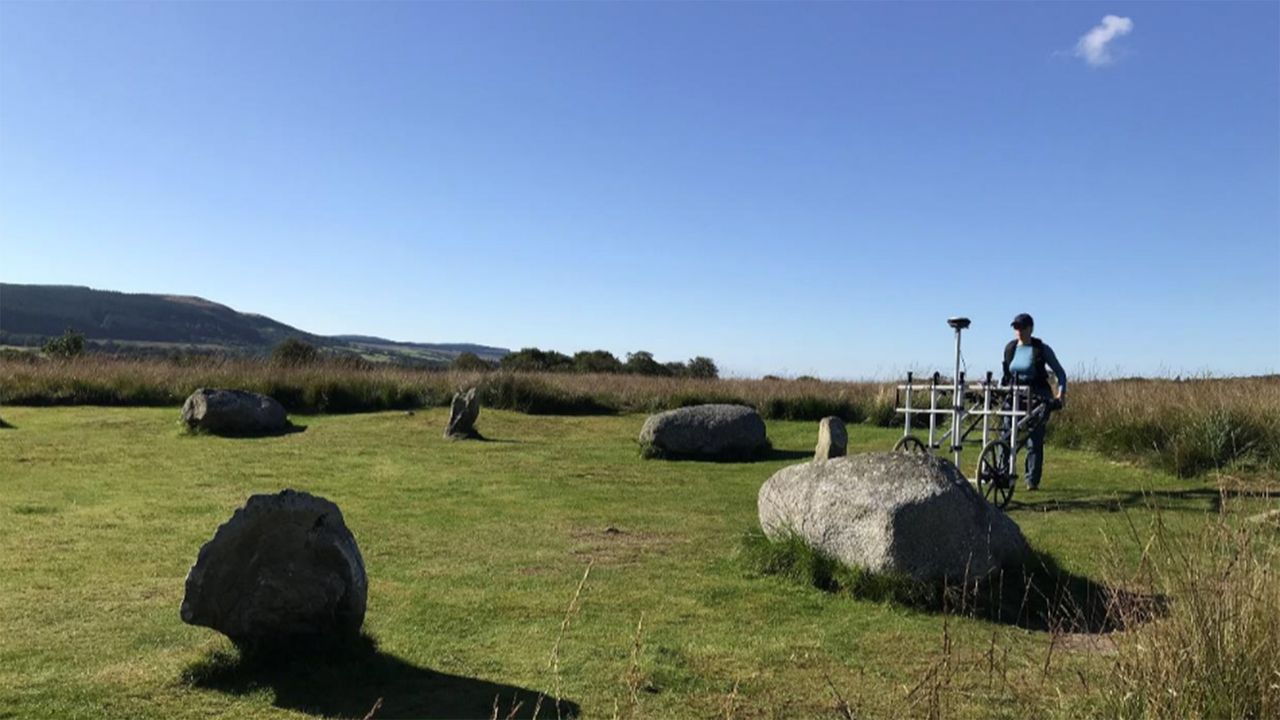
Archaeologists working in Scotland have discovered an underground ring structure at Machrie Moor that may represent an undocumented Neolithic or Bronze Age monument. The detection, made beneath accumulated peat layers, suggests a ceremonial site comparable to Stonehenge, though smaller and predating the famous English monument.
The ring was identified through geophysical surveying techniques that penetrate the overlying peat without excavation. The structure consists of either stones or timber posts arranged in a circular formation, typical of ritual monuments from the Neolithic period (approximately 4100 to 2500 BC) or Bronze Age (2500 to 800 BC).
Machrie Moor, located on the Isle of Arran off Scotland's southwest coast, already hosts several known standing stone monuments. The newly detected ring adds to this concentration of prehistoric ceremonial activity in the region. The peat covering the feature preserved it from degradation and damage over millennia, effectively freezing it in time.
Geophysical surveys employing ground-penetrating radar and magnetometry allowed researchers to map the buried structure without disturbing the archaeological context. This non-invasive approach provided clear evidence of the ring's dimensions and composition before any excavation.
The significance of this discovery lies in the pattern it suggests about Bronze Age and Neolithic settlement patterns. Ceremonial monuments clustered in particular landscapes often indicate places of repeated ritual importance. Whether constructed at the same time or across different periods remains uncertain without excavation.
The research team has not yet excavated the site, prioritizing preservation. Future investigation would likely employ careful stratigraphic excavation to determine the ring's age through radiocarbon dating of organic materials and artifact analysis. Establishing the feature's exact chronology and purpose requires physical examination of the deposits.
The discovery demonstrates how peat-covered landscapes conceal archaeological evidence that conventional surface surveys